




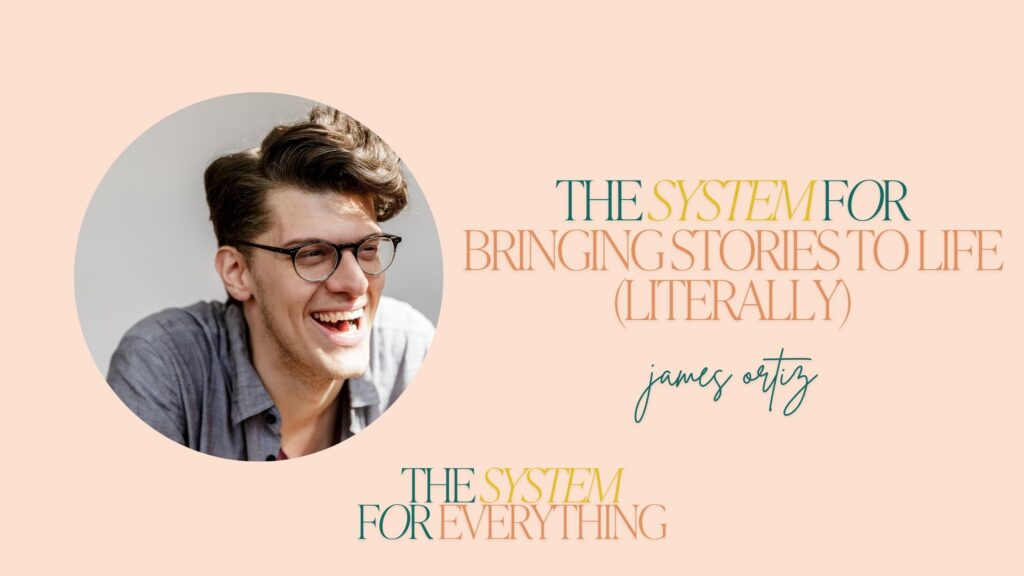
Systems are not always spreadsheets and SOPs. Sometimes they are latex, foam, fishing line, breath, timing, and a performer learning how to bring an inanimate object to life. In this episode, I sat down with director, performer, and designer James Ortiz to talk about the systems behind puppetry, the creative discipline required to build emotional experiences, and why practical artistry still moves audiences in a world obsessed with CGI.
James has created unforgettable puppetry for productions including Into the Woods, The Skin of Our Teeth, El Niño, Hercules, and many more. In our conversation, we went from college memories in Texas to Broadway cows, movie monsters, Ryan Gosling, and the surprisingly rigorous structure behind making a puppet feel real.
Review the Transcript
Julie: Welcome back to the System for Everything podcast. Today’s system reminder systems aren’t just spreadsheets. Sometimes they’re latex rigging and a guy crouch behind a rock. Today’s guest is James Ortiz, a director, performer, and designer who has been lucky enough to create puppetry all over the world.
His Milky White for the Broadway revival of Into the Woods, as well as his dinosaurs from Lincoln Center’s. The skin of our teeth have become fan favorites. Even tattoos. Most recently, El Nino at Metropolitan Opera. Three houses at Signature Theater. Disney’s Hercules at Paper Mode Playhouse. Poor yellow rednecks at A-C-T-S-F Canid at Skylight Music Theater.
Kiss my Aztec at Hartford stage and additional credits include the Kennedy Center. Public Theater City Center, the Muni, Carnegie Mellon, Dallas Theater Center, Yale Rep Theater for a new audience, Shakespeare Theater of dc, ars Nova, and New World Stages. In 2016, James became an OB winner for Puppetry Design for his off-Broadway creation, the Woodsman.
And in 2020 he was named by American Theater Magazine as six theater workers. You should know James became a drama desk winner in 2022. For skin of our teeth and James’s original Milky White puppet can now be found on display at the Museum of Broadway. Notable upcoming projects include Lincoln in the Bardo at Met Opera and the film project Hail Mary starring Ryan Gosling.
That’s where people were Just one step away from Ryan Gosling on the podcast, James. That is what I’ve been telling people for weeks. I’m like, I feel like if Ryan GOs. Met me and had 10 minutes, he would do it. He seems really nice.
James: Uh, can confirm he’s the loveliest human that you’ll ever meet in your life.
Julie: There you go, guys. Next week on the podcast, Ryan Gosling probably
James: all done. Um, also, I really should have cut that bio down for you because it was No, I loved it. It was like a nightmare listening to all of that and also calling somebody a theater worker sounds like I’m working a street corner and like holding a red curtain, being like, can I dance for you please?
Julie: And I
James: don’t,
Julie: I assume that’s what the article was about.
James: Oh, I should have read it.
Julie: Oh guys, so James, James and I started out going to college together. This is gonna be a bunch of nonsense and I’m so excited. Alright.
James: Yeah, it’s, should we talk about how we met?
Julie: Sure. But first we’re gonna get into the system. Read bit.
James: Oh yeah, you do that. Do that.
Do
Julie: that. Quick little reset to start our episode with some humor and humanity.
Alright, James, if a puppet version of you walked in the room, what material would it be made from? Felt foam, cardboard, and anxiety.
James: I think it probably would be made out of like, oh God. It would be like a chunk of foam and like twine.
No, it’s art.
Julie: Something you always intend but never actually get.
Oh my God.
James: Same like, like any kind of workout. Like literally today I found out that in my neighborhood there’s like a, uh, I love rollerblading. Okay. And I used to do it quite a bit, and we moved, and I, there basically there was like a, there was like a tennis court near my home that had smooth concrete that I could roller blade around for hours in a circle, like a maniac.
But I just found that there’s a, a tennis court around here that no one has ever asked. So it’s like, oh yeah, I can do it now. Let’s see if I do.
Julie: I’m gonna check back in in like six months. See how many sense he bla? Yeah,
James: yeah, yeah, yeah, yeah. Every time I put it on and went, I’m tired again.
Julie: Alright. What could you give a TED talk about that has nothing to do with your work?
James: Oh, you know what? I would talk in great detail about the intersection between. Universal movie Monsters and the creation of Batman in the comic books. I, I have so much to say about this and the TLDR is that he was created during a period when you would go to the nick all the time, or the Nickelodeon or whatever you wanna call it, and like, it’s like a one to one of like, uh, a lot of the villains are taken from silent movies or 1930s like noir things like the Joker is a ripoff from.
A silent movie with I think Chaney, where he has red.
I. You got you. You got me started on it, so thank you. Now I have a first draft.
Julie: Alright everyone, you have met the personality. Now meet the powerhouse because while James May be stitching fur and carving foam, he’s also engineering emotion, motion and meaning. Here’s my conversation with James on the system for bringing stories to life, literally.
Okay? Yes. So how did we meet?
James: Okay. First of all, you have the best NPR vibe I’ve ever heard. Um,
Julie: oh my God. What a compliment. Thank you.
James: You’re doing great. You just need like quiet jazz playing in the back and then you’ll fully, like, you’ll fully be doing it. Okay. So we both met at a community college in Plano, Texas.
Mm-hmm. That at the time was called. Quad C Collin County Community College. Four Cs.
Julie: Yeah.
James: Um,
Julie: and I don’t know if it still is, but when we went there, at least like the year before or something, it was named like one of the top theater programs in the country. Even though it was such a small, little middle and nowhere Texas school.
James: I mean, I was the theater club president in my high school. It’s not a big deal. I’m just like everybody else. But I put, I was also the best leg at a time
Julie: President.
James: I’m sure. I’m sure you were. Um, but, uh, uh, so I was definitely like trying to figure out like, what should I do for college? I had no idea, no plans, and I didn’t, I also, um, famously and still am like, not.
Uh, a great researcher of, I, I love my industry and I love working in the theater, but I, I don’t, I don’t obsess about it all the time. Like, I’m not like, God, I can’t wait to find out about this next production or whatever. It’s like I, I like to find out what’s happening, but I’m not like a deep researcher in that way about that.
I research other nerdy shit that makes me happy, but, um, as evident for my Ted Talk. Um. Um, so I was looking for a place, and it seemed like this was a really cool option and I knew the Quad Sea at the time was like a feeder school to many other schools all over the country. Yes.
Julie: Yeah.
James: But what was amazing is that I ultimately went to SUNY purchase like four years after I met you.
Julie: Mm-hmm.
James: And what was amazing is that like, it was an incredible program, a conservatory, you know, um, acting school, classical theater, really, really special. But everything that I was being taught there. I had already been taught at Quai, like, which also makes you go like, that’s, but it’s true. You know, like what an investment.
Julie: Yeah. Our classes were like $900. Like it was stupid out community college.
James: It was crazy. I
Julie: mean, the books were usually more than the classes. They
James: still are. They always are. And I definitely paid full price for every book that I needed for a class, ever. I definitely didn’t find it online or, uh, steal it. I dunno what you talk.
That’s it.
Julie: That’s
James: the police coming. Police coming. But I met you there and we, um, did a lot of theater together and we became like part of a group of like young weirdos who were just really passionate about making stuff together.
Julie: Oh, it truly was. Just a very formative and amazing time in my life. Yeah, and I think a lot of people might look at what you, you do currently with puppetry and stuff and kind of think like, oh, you must have been this like silent like tech guy.
But like that’s not the case at all. I mean, you were right there on stage with the rest of us and ridiculously talented, I might add. Very sweet. So I wanna know kind of how did you go from performing to designing creatures that absolutely steal the show?
James: Well, it actually has to do with quad C.
Julie: Yes, it
James: does.
So it sure does because, so I, you know, I, while I was at quad c before I left the, the, the chair sort of was like, Hey, before you go, let’s do something with puppets. Because they, at that point in my life, puppets was sort of like. Do you have anything fun about you? Like do you have a fun fact? And my fun fact was like, had had had some time playing around with marionettes and I thought it was cool, but it was always gonna be like special skills, you know?
Yeah. Or like, and do accents. Like it was always gonna be at the bottom of the resume. And I went to this acting conservatory, four years of Chekhov and Shakespeare and crying in the snow and you know, existential alienation and all the things that Chekhov needs to be, be, and I loved it. And then, you know, I, I found that I didn’t have an, have an avenue there for the other passions that I have because I was always like a painting, drawing, sculpting person.
And I also was always very interested in performance and I didn’t know how to bring it together. And of course, puppetry is the center of the Venn diagram of fine art and performance. So finding that was like, what a huge moment, but didn’t.
I graduated and was like ready to do Shakespeare for the rest of my life. And no, there was 0.0 phone calls and I did get a call from our mutual friend, Andy Bean.
Julie: Yes.
James: Who, who, uh, K and also went to purchase.
Julie: There are lots of places. You guys may have seen him on your screens Most recently, he was a dad on Grey’s Anatomy.
I was excited to turn on the TV and see that he was a big, uh, plot point at the end of the season. The cliffhanger.
James: He also was one of the adult versions of the children in the second IT movie.
Julie: Yes.
James: And uh, he also was in this Swamp Thing show. He he’s an extraordinary performer.
Julie: Yeah.
James: And I’ve
Julie: known him since I was, I think 16.
And he was always that good.
James: Yeah. Devastating.
Julie: Yeah.
James: And basically he reached out to me and said, Hey, um, I got this. Audition that I can’t make for this puppet opera that’s happening at this theater in Times Square called The New Victory Theater, which is basically a sort of really ple children’s theater that does like really interesting work and Moises Kaufman of the Laramie project.
Yeah, with. I was directing it.
Julie: Oh, wow.
James: And it was a co-pro with Gotham Chamber Opera. So it was like, I had no experience in opera, but I had a lot of experience in puppetry and I had made a puppet during purchase days to like keep me fueled. And basically I just went to the audition, I brought that thing, I wiggled it around and I got the job and I sort of met.
A lot of like the Brooklyn Basel twist, like puppet elite of New York City. Um, and started stealing their best ideas, frankly. Um, uh, you know, and, uh, I worked with this Bri, it was a British puppet. Um, at that time it was called Blind Summit and it was, uh, Nick Barnes and Mark Downs and Nick Barnes famously now is responsible for designing the Tiger in Life of Pie.
Oh. And has won many awards and I basically worked with that team. And learned so much. I mean, I already was really passionate and furious about how to do it, but the way they structured rehearsals, I was like, oh, I think I know how to do this. So I just started making my own work from there. And then one thing led to another, and then I became a gun for hire for other people’s big Thad Theater dreams.
Julie: I’m sorry, I for a second. I was laughing because I forgot for a moment that Life of Pie went to Broadway and was not just. A movie with an actual tiger, and I was like, wow. How? Wow.
James: Yeah, yeah, yeah, yeah, yeah, yeah, yeah, yeah.
Julie: Okay. Okay. Back to it.
James: No, it’s a beautiful, it’s a beautiful show and the puppetry, and it’s like devastating.
But basically, yeah, I mean that’s sort of how, and I think what’s interesting is that I also get this question of like, so you were an actor, but you’re not anymore. Like, do you know, like, did you just like waste your whole degree? And it’s like, no, because. There’s not a day where I’m not using all of that stuff.
And like action and objective and Stanislavsky and all those kind of pretentious conversations, you know? Yeah. Are, are a part of this because ultimately a puppet is a tool for an actor to act through. Yeah. So I think the thing that’s like afforded me having any career is that I speak theater as opposed to.
I speak fine art, which I think a lot of puppet designers sort of do. A lot of them went to really extraordinary art schools. And there’s maybe less of an interest, and I’m general, I’m generalizing, but there’s less of an interest in sort of storytelling and structure and character. It’s more about visual and that’s great.
Um, sometimes you have to make a spectacular, but I think, um, what I’m, what I’m grateful to is the fact that I speak. I speak, you know, dramatic structure and character. Um, so yeah, that’s sort of it.
Julie: I wanna get into like the nerdy systems part of it, like your process, right? When you are handed a script and asked to build a character that does not exist in the real world.
I mean, where do you even start? Is it sketches, is it trash from your garage? Like what? Like where do you start?
James: I wish I had a. Specific one way I do it every time, but I’ll tell you, you know, because it’s very different, right? Because it’s,
Julie: yeah, of course.
James: And I sort of, I sort of am approaching it like an actor and an actor will always sort of start wherever the inspiration is.
But um, I’ll tell you what I sort of tell everybody when I have a Zoom and I’m sort of. Interviewing for the job, and I sort of talk about how this process works, which is generally like any other designer in a theatrical process or even a cinematic process, whatever. You’ll sit with your director and the creative team, the set designer, the costume designer, everybody, and will just sort of share artwork.
That’s usually how it always starts, like a Pinterest board of like, I think the show looks, smells, and feels like this, and then we discuss it so we can start honing in on what the show wants to actually be. And from There we go. Cool. I know I have these four moments that are, I’m responsible for and it’ll become usually a bunch of sketches.
I’ve lately been getting into using this program called Sea Brush, which is basically three digitally sculpting a 3D model.
Julie: Oh.
James: Which is so fancy and makes me look so much fancier than I’m, but the cool part. The cool part is that I can basically send it to somebody with a 3D printer and they can print it and then they can pull patterns from it.
Julie: Oh, cool.
James: It’s a total game changer. And there’s also so many programs that exist that you can take that file and hit a button and it becomes flat patterns like a dressmaker. For,
Julie: for the record, what you’re hearing is the background of James living in New York City. Um, this is real life. People are real life people.
There are emergencies. I just wanted to give people a heads up that it wasn’t like outside of their car.
James: You should know they’re taking me away because
Julie: Oh, no. Oh, is that why they’re strapping you down right now?
James: That’s right, that’s right. I love puppets. Let’s talk about that, man. Um, I just feel like working in puppets means I’m just one step away from fully being a mad person because it’s such a weird, it’s such a unique and bizarre job that you have to sort of spend every time and explain it to everybody that you work with because is a different.
But again, back to process. So it’ll be a, it’ll be a bunch of sketches, it’ll be a bunch of, sometimes I make models depending on the director’s desire for more tangibility to understand the physical object of what it’ll be. Um, and then usually we get cracking on building it, um, in ver it, depending on the budget.
Sometimes I get to have a long time to build and sometimes I have no time to build. Um, and it depends on the process and, um. I’m sure I can give you more specific examples later, but um, and then I’m also a puppet designer and a puppet director, and that’s always a negotiation of comfort because it basically means I’m sort of the puppet’s choreographer if, for lack of a better reference, so I am in the room with them sort of invariably.
It’s usually a performer that’s never puppet before because the time probably been cast. Sometimes they’re like, oh, we forgot there needs to be puppets. And we sort of try to navigate that quickly. But basically I’m teaching puppetry to people that have never done it before and I’m sort of the puppeteer acting coach is a good way that I also put it where I, you know, the thing that I’ve learned, and I’ve said this many times, is that.
You know, to be a puppeteer, you are literally controlling something and it’s a, it’s quite detailed and specific, and you’re like, no, no. The breath is like, it’s sometimes really exacting to make the performance. Work and read. It’s sort of like sometimes even like the rules of comedy, where comedy is sort of very exact in order for it to land and be funny sometimes it’s not just a loose sort of thing.
Julie: If your business couldn’t run without you, that’s a problem. A haunting your assistant from the beyond kind of problem, enter the entrepreneur’s death folder. It’s your digital contingency plan. Think of it as the world’s least spooky survival guide for your business. All your logins, contacts, workflows, and need to knows in one tidy place because peace of mind is the ultimate productivity tool.
Grab yours today@dallasgirlfriday.com before life throws a plot twist. In a world that’s obsessed with CGI, like, what do puppets still offer that digital effects just cannot replicate?
James: Well, you can feel it from like the movie Jurassic Park, the movie, the movie of Little Shop of Horrors. You can see it in Rick Moran’s eyes that he’s talking to something that’s right there.
You know, it’s, we’ll talk about this project that I did, which is humorously called Project Hail Mary, but it was one of those things where it didn’t. It wouldn’t have been fair on Ryan to have
Julie: to play. He’s speaking about Ryan Gosling, friend of the show,
James: friend of the show. It wouldn’t have been fair because for all intent purposes, a lot of that story is a two-hander between Ryan Go’s character and this alien, which is played by a variety of puppetry and effects, and it’s a collaboration of many things.
But it wouldn’t have been fair for Ryan to have to. Like what the other character is playing if there’s nothing there and up that character and so. You know, it’s funny because theater has always been the low-fi medium, and something that I have noticed is that every time that there’s a recession, there’s usually a, a a, a sort of windfall of puppetry on Broadway usually because it’s a low-fi effect that is really potent and powerful.
You know, sure it can cost money, but it’s maybe not as much as like other things.
Julie: Yeah.
James: So it’s, um. Just think it’s a medium. It’s never gonna go away. I mean, there is historical precedent that it was, it puppetry predates actors on a stage. Like, you know, there’s, it, it for a variety of um, uh, religious beliefs.
It was not appropriate for a person to get on a stage and perform in that way. It was okay to sort of create an avatar and tell a story that way. So I think there’s something so old world about it and therefore like speaks to the deep subconscious of imagination,
Julie: you know? Yeah. I feel like there’s definitely a kind of reverence when an audience knows that something is real.
James: Yeah.
Julie: Um, have you ever had a moment on a set or in a performance where you could tell that the puppet moved someone emotionally?
James: Yeah, I mean, it’s, it’s funny, it, it usually just means a different type of listening takes place. Mm-hmm. Um, sometimes it just gets quieter or it gets more reactive, moves crazy for Milky White, for Into the Woods, both at City Center and Broadway.
Was that like it? I was so surprised because there was a very quick rehearsal process. We sort of did the whole thing. We were kind of in tech and you kind of can’t tell if anything’s working because you haven’t had an audience in. Ever. And we had our first invited dress and like the cow just got such a focal response from the audience.
And
Julie: that cow was all over my Instagram feed. I mean, constantly.
James: It was crazy actually.
Julie: Um, it was so fun to see.
James: It was it. It is and it remains really fun. There still is like a, um, like a TikTok Instagram like sticker that is the cow’s head that you can,
Julie: oh my gosh.
James: Type, type in milky white and you put it to use.
But, um. It was this really extraordinary response that I couldn’t have expected, but somebody way smarter than me said this. Uh, a puppet designer named Dan Len, um, said, I’m gonna butcher this quote, but, so it’s, uh, this is deeply paraphrased, but you know, ultimately the audience knows that that actor is not actually that character.
Like we fundamentally know that. But a puppet was made to be that thing. There is no sort of in between, you know, whether that there’s a performer operating it, but in a funny way, there’s a different level of almost subconscious investment that takes place because we just know that that cow is that cow that is made to exist in these woods and be Jack’s best friend.
Like there’s sort of, you know, it’s, it’s like you have conjured a character as opposed to are playing a character and that sort of puppet versus.
Because you can sort of feel an audience in a funny way, like believing in dolls again, like Woody’s here. Like you can, you can really feel it. Uh, when I did the Woodsman a long time ago, there was, I was in that show and I was very busy Mo doing a lot and physically on stage, but there was a couple of scenes I wasn’t in and it was this, a lot of scenes with this sort of witch boom, rock who puppet character, who’s this miserly, scrooge, you know, really kind of antagonist of the story and.
It was really interesting watching the audience’s face watch her because their face turned into hers, like they just started. You could just see their little face hardening because they’re just under, they’re trying to understand what this face that doesn’t have, you know, mechanisms. There’s no eyebrow move, there’s no mouth move, but their, their superimposing, the feeling that they’re feeling about the character.
So you would have very different reactions. After the show, you’d have a talk back and they would go, I think the character was doing this. And you’re like, okay, that’s not what we intended. But like it’s, it’s, it’s, it’s engaging a, it’s like reading a book privately. It’s like your experience of it.
Julie: Oh, I
James: love
Julie: that.
James: It’s really bizarre and I, it’s so hard to explain, but that’s the, I think it’s probably one of the reasons why I keep doing it. It’s just so
Julie: are routines.
Keep that creativity Well from running dry or your deadlines from running over.
James: Deadlines help. But I mean, it is interesting because I, I’m really fortunate to have a career. I’m really fortunate to be working, but it is a thing where even now. I struggle to make things. For me, I struggle to like, make stuff just for like, I have off, I, I have time off and like, how am I gonna fill this time?
And sometimes it’s about just recuperating because you know, an entire rehearsal process is fast and intense and you’re working, working, working. So sometimes you just wanna be under the covers. But when I am sort of struggling to and to be inspired, it, it usually comes from. Taking other art that may have nothing to do with the theater.
You know, I love gonna see plays. I love gonna see new musicals and, and, uh, I have a lot of favorites from this season, but it was, it sometimes it’s about gonna like the Met Museum here and just getting inspired by art history because, you know, the, the, the wild thing and the thing that I love about what I do is that it, like I said, it’s the center of the Venn diagram of fine art and performance.
So. I try to fill all those cups as much as I can, like watching a movie with a great performance in it or, or some, a film that does something really unusual or you know, has a daring idea or concept in it. That really gets me going. But also like trying to be inspired by what the art is. I mean, I think you probably.
You remember this because there was sort of this old, um, very sort of tri and true like theater worksheet, actor worksheet that every actor was given at some point where it’s like, what texture is your character?
Julie: Oh my God, I,
James: you know what I’m talking about.
Julie: I can’t even get into how much I hated that stuff.
Like I truly was, uh, I like went to school for theater guys. I literally thought that like. I’m, I I think that if you took 19-year-old me and had her look at my life today, she would be so shocked like that. I don’t have a Tony by now. Like, that’s how highly I thought of myself.
James: Oh
Julie: sure. But like, I absolutely hated the, the literally the systems and processes behind, like what makes so many actors great.
Like to me, I was just like, I dunno, acting’s not hard. You just like do it. You have talent or you don’t, and it’s
James: like,
Julie: oh my god. 19-year-old Julie.
James: But also that is a school of thought that like Anthony Hopkins is very like, learn your lines and just get on set. Like he doesn’t wanna get into character stuff.
Julie: Me and Anthony Hopkins, two of the greats.
James: And that’s what you, that’s what we’ve always said. But also, I don’t know if you would, I think you would agree with this, that like. The, the schooling that you got, you’re still using it all the time. A hundred percent. You know what I mean? Yeah. Because I think a lot of young people would probably go, oh, I betrayed myself, or I gave up on my whatever.
And you’re like, knowledge is knowledge and it’s being used.
Julie: Yeah. And I think one day I’ll get back on a stage, like when my kid is a little older, I think at some point I’ll audition for, you know, a play here or there. I mean, nothing, you know, big, but why wouldn’t I?
James: I think you should.
Julie: Yeah. I need the applause.
It fuels me.
James: I need, I need the applause. Oh, I gotta get it. Oh, please. But, uh, I dunno what I was saying, but I hope it connected to that. Oh, the worksheet. I, I mentioned this because sometimes gonna see like fine art pieces, it becomes like I get to decide what genre of puppet I’m creating. And I don’t mean like marionette, I mean like, what’s the.
I, I’m sitting in a room with the set designer and the costume designer, and my work has to blend into the aesthetic landscape that they’re creating because if it doesn’t, then it stands out in a way that doesn’t help to play. It becomes sort of showboaty in a way that’s not helpful. So, in a fun way, I get to like, do a little bit of art history all the time and go, well, this story takes place in 17th century England, and what’s the materials that would be available then, you know, that’s, that’s the nerdy fun stuff that I get to do
Julie: when people.
Experience your work, and I think they will continue to for a long time, whether it is in a theater seat or on a streaming platform. What do you hope that they walk away feeling?
James: I hope that they don’t get too bogged down with the technical questions of like, how did they do that? But that they were just immersed in the story.
You know, I think that was sort of a surprise success about Milky White and Into the Woods because, you know, there is, has never been a precedent for Milky White being a character in that play.
Julie: No.
James: It’s always like a cutout, you know,
Julie: it’s the, it’s the cardboard thing. You roll on stage.
James: Yeah. And the joke is, look how dumb Jack is.
So, in a funny way, and that Burt right, like he’s not a cow baby. Like, just gonna feel sorry for him. There was something really cool about like legitimizing the character and actually finding an arc. But, um, you know, it’s a similar thing of like, folks generally didn’t get too bogged down when they saw that show of how did it, how is it made, and what is it?
That would be sometime later.
Julie: Mm-hmm.
James: But hopefully they just felt like, oh, this guy’s puppy is sad. No, you know. You’re just trying to like play into the, that that again, that subconscious like child, brain that goes magic is real because that’s sort of the point
Julie: for any creative people who are listening.
What would you say to somebody who is in a rut, like who may be used to love creating but has not felt that spark for a while?
James: It’s a really good question. I mean, I definitely get in ruts, but I have seen so many really talented. Talent is a word that’s overused in this industry. Like sometimes talent isn’t the point.
Sometimes it’s about the chutzpah that you have to kind of keep going. Yeah. You know, but I’ve seen a lot of really talented people get in their own way and sort of decide that they are unworthy of pursuing this. I, I’m friends with just gonna be name droppy. I don’t know. I’m friends with,
Julie: I love it already.
James: Rachel Brohan because she is married to our mutual friend, Jason Ralph.
Julie: Yes. We’re also only one step away from getting her on the podcast people. Let’s make it happen. The last time I talked to Jason was when he had a spot on younger and he kissed Hillary Duff and I texted him and said, because Jason was my first ever stage kiss in college.
And I texted him and I said. Now I have made out with Hillary. He goes, that’s how science works. That’s the last time I’ve talked to him. So I dunno that I quite feel comfortable being like, can we get your wife on the podcast? Do you wanna come on the podcast?
James: I know, I think that’s, you’re, I think you’re completely right.
And that is science. Um, but Rachel, Rachel and I were talking today and it was this really interesting conversation where. I think a lot of artists sort of spend a lot of time going, should I, is it okay to wish and to dream and to want, and Rachel was really refreshing because their natural response is not should I, but how do I,
Julie: oh, I love that.
James: And you just go, oh, well that’s the difference, right? Like I was really fortunate because at the beginning I was surrounded by a lot of people. I would go, is this an okay idea? And they would go, no, let’s, let’s explore it. Like, yes, keep going. And if I didn’t have that, I, it would’ve been a different story.
But at a certain, your own cheerleader. Believe that the idea is worth getting in front of people. You have, you know, you can never think about end game. You can never think about like, I do this and then I get a Tony. Like, it, it, it, it cannot ever do that because in a funny way we can feel it and it’s never gonna work.
But like, if you make something that you are excited about, that you care about. That speaks to you, then I think you’re doing great. One way that the woodsman kept happening, this play that I did in about a decade ago, um, was that I also kept pulling people aside after the show, like friends, you know, uh, and just kind of go like, tell me everything that you thought about it, because I, not, not not trying to get like praise, but to go like, where doesn’t it work?
Because I was really comfortable sort of crowdsourcing. This thing that I was so close to that I couldn’t see the forest for the trees, pun intended. Um, so it’s being comfortable talking to other people about your work and then trying to clock the common threads that they keep saying, loved this, loved this, loved this, this part I didn’t make sense to me.
And you’re like, great, I can work on that. So allow yourself to like believe in yourself and also enjoy the work part of it. If you don’t. If you can’t do that, then you might not do the work. Do you know what I mean?
Julie: Yes.
James: Like I won’t work out because I don’t enjoy working out.
Julie: Yeah.
James: Um, but if I can trick myself into thinking that I do, then perhaps I With
Julie: roller blades.
James: With roller blades kiddo.
Julie: Alright, James, tell everyone where they can find you online. Your website, Instagram, and how they could potentially work with you. I think maybe nobody here is perhaps the Broadway producer, but you never know who’s listening. But they could be.
James: I mean, I, I really love connecting with artists that are trying to figure themselves out.
I sort of have a cup of coffee with like a, a, a puppet or designer or director, hopeful like every few months. And I really enjoy doing that because I think the job is to sort of share what you know and help people get, get, move forward. But. My website is James Ortiz Coco. I dunno why it’s not com that’s just the nature of the beast.
I’m on Instagram and TikTok as jort, like JORT, like j Ortiz, and or if you like Jorts, um,
Julie: who doesn’t?
James: Who doesn’t love a, but, uh, I’m on social media as those things, and I sometimes post up. I think once this Hail Mary thing comes out, I’ll very much be posting more behind the scenes. Yeah, of course I can, but, uh, it’s all gonna be really fun and really cool.
Julie: Yay. Thank you so much for being here today, James. All right. We are gonna close things out with a system shut. Uh, I’m gonna present the five puppets that I believe deserve an ego. These legends have done the work. Now give them the gold. All right, James, do you have five puppets that you would like to share or would you like to just chime in on mine?
James: Uh, why don’t you go first and then I’m gonna share the list that I opened up in my notes app.
Julie: Okay, perfect. Alright, number five, Audrey two from Little Shop of Horrors. She belts, she devours, she commands the stage. Feed her a Tony and a Grammy already. Number four, Grover from Sesame Street. The most underrated comedic actor of our time.
Physical comedy, flawless playing both Grover and Super Grover. That’s Range Elmo. Could never.
James: Yeah, you make a great point.
Julie: Number three. Staler and Waldo from the Muppet Show, the original podcast critics. Their balcony roasts should be required viewing for any aspiring award. Show host number two, Daniel Stripe, tiger from Mr.
Rogers neighborhood. Soft spoken. Deeply emotional and decades ahead of the vulnerability curve. Give him an Emmy for Inner child healing. And number one, my all time favorite, the most classic of all. Miss Piggy, a masterclass in Diva Energy. She invented range. She karate cho the patriarchy, and she somehow still pulled off opera gloves.
James: Julie, that was so thrilling.
Julie: Thank you.
James: And also, th three of them are Frank Oz characters. So I think what you’re really saying is Frank Oz is the best, which I would agree with. Yeah. My list is not beautifully as, beautifully organized as yours. I actually also include Audrey too and mine. Nice. But I’m a big fan of Audrey too, from the film because
Julie: Fair, fair.
James: Extraordinary. But also there was. Between departments to make this character come to life because puppetry doesn’t work unless all the other departments are working together. Um, you know, there’s a funny thing that, uh, I found out later in life that because the plant has so much complicated lip-syncing to do in the movie.
They would slow the track down. So it would be like, so that they could have, because it’s just guys with leverage.
Julie: Oh, so they could have it look like a, whoops. Wow.
James: Exactly right. So when it’s really fast patter song moment, you may notice that Rick Morran is back is to the camera because you would see that he’s moving very quickly because they sped it up afterwards to match the track.
Julie: Oh, that
James: makes sense. A lot of the, a lot of the most complicated stuff that you’re like, how did they do that? Is because they took the time on set to slow everything down so they could get really detailed with every like phony and like where the tongue and the teeth go. It’s extraordinary.
Julie: Yeah.
James: Um, I love that.
I also love, I have to say Richard Parker, the Tiger from the life of pi. Mm-hmm. Um, Broadway and Broadway tour. It’s an extraordinary puppet. I say Joey from war because it was this. I started making puppets. I started working in puppetry around the time that that was becoming something. So I think I jumped on the bandwagon when it was extra popular, and that really helped me.
But also the detail and the work in that show and the physical labor of carrying this ratan. Around was extraordinary. I also was gonna say the T-Rex from Jurassic Park, it’s an animatronic, but baby that’s alive and that’s incredible. And also a, a collaboration between a lot of departments. And I also said, um, very self servingly, milky white because I think she’s sweet baby.
And, um, I’m very, very, I’m just surprised and pleased. I mean, there’s more than one human in the world that has a tattoo of Milky White.
Julie: I, you would repost it every time someone posted about it on Instagram and I was like, that is the weirdest and coolest thing.
James: It is. There are, there are about six people in the known universe that tattoos of my work, and I think I’ve only met two of them.
And it’s really shocking moving, and I don’t know what to do with that information. Oh, other than. You know.
Julie: Oh my gosh. All right everyone. That is a wrap on this week’s episode. James doesn’t just build puppets. He builds wonder, watching him take foam and fishing line and turn it into something with a soul.
It is a reminder that systems aren’t just in a Google Doc. They can be scaffolding for magic. If you wanna see more of James’s incredible work. Visit James ortiz.co and keep your eyes peeled for his next big project. You’ll know it’s his if the creature makes you cry a little. If you love this episode, be sure to follow rate and share the system for everything.
And if naming your own puppet egos sounds silly, try it anyway. It’s weirdly healing for your inner child. See you next week.
This episode is brought to you by The Entrepreneur’s Death Folder:
If your business couldn’t run without you, that’s a problem—a haunting your assistant from the beyond kind of problem. That’s where the Entrepreneur’s Death Folder comes in. It’s your digital contingency plan: all your logins, contacts, workflows, and need-to-knows in one tidy, shareable place.
Less spooky, more smart. Because peace of mind is the ultimate productivity tool.
The System Behind Creative Magic
When most people think about systems, they think about business infrastructure—checklists, workflows, automations, and operations. But what became clear in this conversation is that systems exist anywhere something is created consistently and collaboratively. In puppetry, the system begins with understanding the story and expands into visual research, collaborative conversations, sketching, prototyping, building, and ultimately performance. While the exact starting point may shift depending on the project, the underlying structure remains steady enough to guide the work from idea to execution.
That structure is what allows creativity to function at a high level. Without it, ideas stay abstract and disconnected. With it, they become tangible, repeatable, and sharable. What I loved most about James’s approach is that his process is not rigid—it is responsive—but it still provides enough consistency to support complex, collaborative work under real deadlines.
From Acting to Puppetry: A Nonlinear Path That Made Sense
One of the most compelling parts of James’s story is how unexpected his path into puppetry was. He began as an actor, fully immersed in classical training and performance, with puppetry sitting quietly as a “special skill” rather than a career focus. It wasn’t until later that he realized puppetry allowed him to combine two core parts of his identity: visual artistry and storytelling.
Instead of choosing between disciplines, he found the overlap in puppetry.
What stood out to me most is how his acting training didn’t go to waste. Every puppet he designs must function as a character with intention, emotion, and purpose within a story. That requires an understanding of the art of performance. Skills rarely disappear; they often reappear in new contexts in ways we didn’t anticipate.
Why Puppetry Still Matters in a Digital World
CGI seems to dominate film (and even theater) these days, so it’s easy to assume that artistry in puppetry is becoming obsolete. James explains why puppetry continues to resonate and how the difference comes down to presence. When an actor performs opposite something real, their reactions are more believable. That physical interaction creates a level of authenticity that audiences can feel, even if they don’t consciously analyze it.
In projects like Jurassic Park and Little Shop of Horrors, those practical effects bring a sense of weight and immediacy that is difficult to replicate digitally. Puppetry doesn’t compete with CGI—it offers something entirely different. It invites the audience into a shared physical experience, one that relies on imagination rather than illusion alone.
James recently had the opportunity to work on Project Hail Mary, the upcoming film starring Ryan Gosling. In that project, much of the story centers around the relationship between Gosling’s character and an alien—one that is brought to life (by James) through puppetry and practical effects rather than relying solely on CGI. As James explained, it wouldn’t have been fair to the actor to perform against nothing. Having a physical presence on set allows for a real interaction, which ultimately translates into a more grounded and emotionally believable performance on screen. It’s a perfect illustration of why puppetry continues to be such a powerful tool, even at the highest levels of film production.
There’s also something deeply historical about puppetry. It predates modern theater and taps into a long-standing human instinct to project emotion and meaning onto objects. That connection to storytelling tradition is part of why it continues to feel so powerful today.
The Emotional Power of a Puppet
One of the most fascinating insights from this conversation was the idea that while audiences know actors are playing characters, a puppet is made to be that character. That distinction changes how people engage with what they’re seeing. Instead of evaluating performance in the traditional sense, audiences often accept the puppet at face value and emotionally invest more quickly.
James saw this clearly with Milky White in Into the Woods. Traditionally treated as a comedic prop, the character became something much more when given presence and intention. Audiences didn’t just notice the design—they connected with the character. They felt something.
That shift—from observation to emotional investment—is what makes any creative work successful. It’s not about impressing people with technique; it’s about immersing them in an experience.
Collaboration Is the Real System
Another theme that came through strongly is that puppetry is inherently collaborative. The work doesn’t exist in isolation—it must align with the broader visual and narrative world of the production. That means constant communication with directors, set designers, costume designers, and performers to ensure that everything feels cohesive.
But the collaboration doesn’t stop once the puppet is built. In many cases, James works directly with performers to teach them how to bring the puppet to life. Timing, breath, and precision all play a role in making the performance believable. This transforms the process into something more than design—it becomes a shared language between object and performer.
It’s a reminder that the best systems don’t just produce results; they support the people using them.
Navigating Creative Ruts
Like any creative professional, James experiences periods where inspiration doesn’t come easily. Instead of forcing output, he focuses on input—seeking out art, film, theater, and experiences that reignite curiosity.
This is something I think a lot of people overlook. When we feel stuck, our instinct is often to push harder, but sometimes the real solution is to step back and refill the well. Exposure to different forms of art and storytelling can unlock new ideas in ways that direct effort cannot.
The Question That Changes Everything
One of my favorite takeaways from this episode was a simple but powerful mindset shift. Instead of asking, “Should I do this?” James talked about the importance of asking, “How do I do this?”
That shift moves you from hesitation into action. It assumes that the idea is worth exploring and focuses your energy on execution rather than permission. For anyone who feels stuck or uncertain, this is a powerful place to start.
Because creativity isn’t just about having ideas—it’s about following through on them.
The Real Takeaway
This conversation wasn’t just about puppetry; it was about how meaningful work gets made. It was about the balance between structure and imagination, the importance of collaboration, and the courage to take your own ideas seriously.
At the center of it all is a truth that applies far beyond theater: systems don’t limit creativity—they support it. They give your ideas somewhere to land, something to build on, and a way to move from concept to reality.
Magic may feel spontaneous to an audience, but behind the scenes, it is carefully constructed. Whether you’re building a puppet, a business, or any kind of creative work, the principle is the same:
Magic needs structure.
Broadway Shows Mentioned
- Into the Woods
- The Skin of Our Teeth
- Life of Pi
- Little Shop of Horrors
- War Horse
Movies Mentioned
- Jurassic Park
- Little Shop of Horrors
- It Chapter Two
- Project Hail Mary
Shows Mentioned
- El Niño
- Lincoln in the Bardo
- The Laramie Project
- Grey’s Anatomy
- Swamp Thing
- Sesame Street
- The Muppet Show
- Mister Rogers’ Neighborhood
- Younger
Connect with James
Website: jamesortiz.co
Instagram: instagram.com/jortface
TikTok: tiktok.com/@jortface