




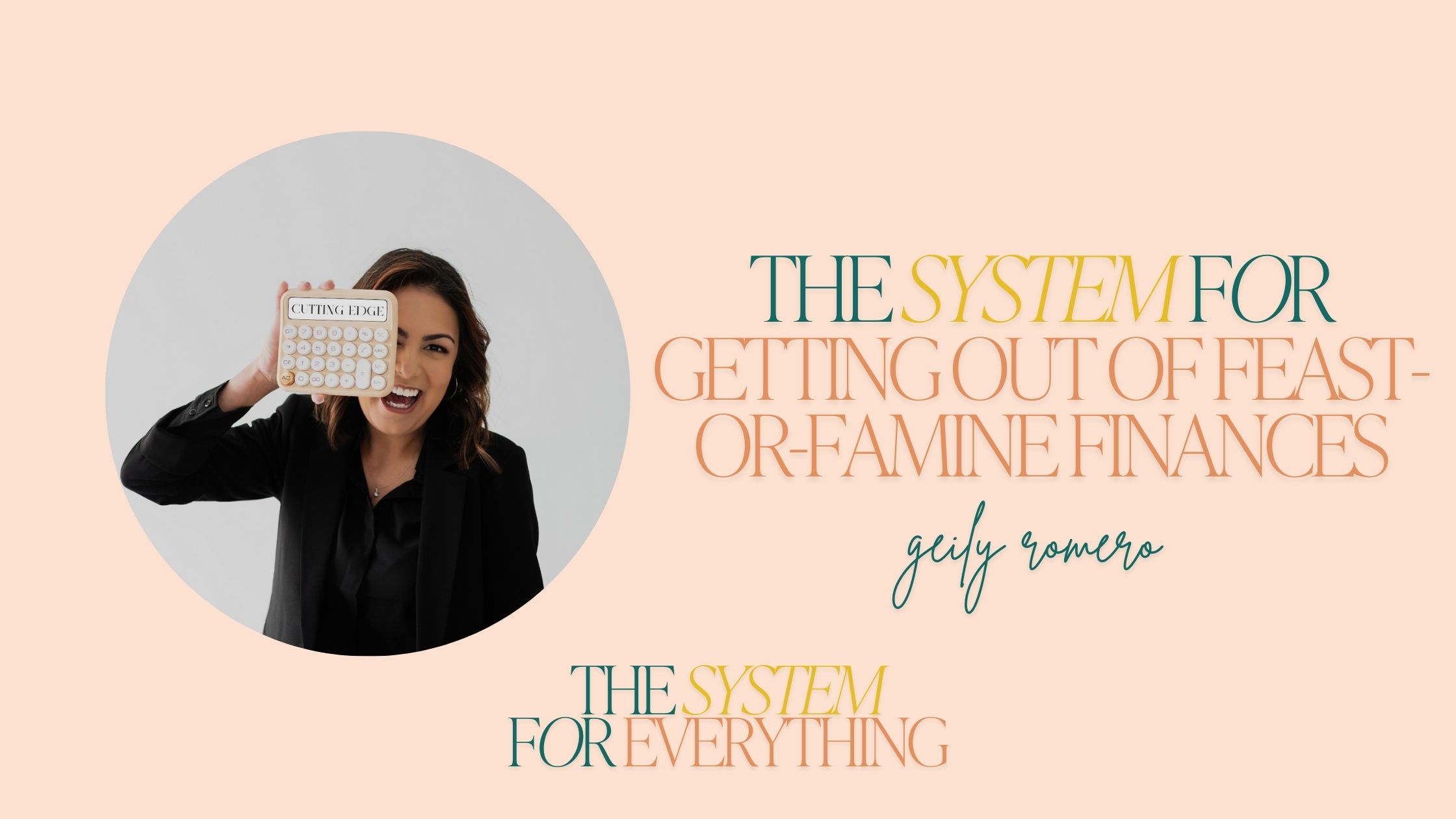
If your finances feel like a rollercoaster, it’s time to stop screaming and start steering. You’re not alone if your business bank account swings from dopamine highs to devastating lows. One month you’re flush with client payments, the next you’re wondering if Stripe has ghosted you. The feast or famine cycle is a real (and exhausting) part of entrepreneurship, especially for creatives and service providers.
In this episode, we’re joined by fractional CFO and financial consultant Geily Romero to unpack why this happens and how we can build systems to stabilize our cash flow without burning out. Geily has spent nearly a decade helping service-based entrepreneurs stop guessing and start growing with intentional, sustainable financial strategies.
This episode is brought to you by Enji:
Tired of winging your marketing? Enji takes the guesswork out of showing up. This all‑in‑one marketing system was built specifically for creative entrepreneurs who want consistency without burnout. Plan, schedule, and track your content with intention—so you can stay visible, stay top‑of‑mind, and still have a life.
Why Creatives Struggle With Consistent Cash Flow
We often talk about marketing systems, client onboarding systems, even automation tools—but your finances? That’s usually managed with crossed fingers and last-minute calculations. Geily describes this as money blindness (a cousin of time blindness) where everything “should” take an hour and somehow eats five.
With money blindness, we keep financial plans in our heads, making quick decisions based on our bank balance instead of thoughtful strategy. Geily calls this “bank balance accounting,” and it’s one of the most common traps creative entrepreneurs fall into.
The result? Erratic decisions, panic-fueled paydays, and avoidance until the IRS knocks.
Revenue Is Not the Goal. Profit Is.
If you’ve ever side-eyed a “six-figure launch” post on Instagram, you’re not wrong to feel skeptical. Geily made it a priority that her clients are crystal clear on one thing: revenue ≠ profit.
Revenue is just the top-line number. What really matters is what’s left over: your profit. That’s what pays you, builds your savings, and sustains your business long-term.
So if you’re bringing in 10K or 20K months but still feel broke or can’t pay yourself? You’re not broken, but your systems are.
The Power of Percentage-Based Budgeting
One of Geily’s most practical tips is deceptively simple: assign every dollar a job.
Using percentage-based buckets (think: 50% to operations, 30% to owner pay, 20% to taxes/savings), you can create a clear, repeatable way to manage income no matter how much you’re bringing in. The actual numbers may vary, but the principle is the same. Don’t let your money wander around unsupervised.
This system is especially powerful for people who “just check their bank balance” to make decisions. By separating your income into different bank accounts or categories, you can visually see what’s actually available, and avoid accidental overspending.
Small Habits That Make a Big Financial Impact
If the idea of building a full financial plan feels overwhelming, start here:
Do an Expense Audit
Look at what you’re currently subscribed to and ask: Does this move the needle? Keep what serves your goals, downgrade what doesn’t, and cancel the rest. Even small wins like canceling a $10 monthly subscription can build momentum.
Open a Reserves Account
Create a separate savings account and start transferring just 1% of your revenue into it. If you make $5,000 this month, that’s $50. It’s small enough that it doesn’t feel scary, but powerful enough to build consistency.
Automate What You Can
Use tools like Qapital (my favorite!) or your bank’s automation features to move money automatically. If an app helps you save when you’d otherwise forget, it’s not a waste of money. It’s actually a system.
What to Do When Business Slows Down
Even with great systems, your business will have slow seasons. The difference is how you handle them. Will you panic or will you be prepared?
Geily recommends focusing on what you can control during these seasons: expenses, savings habits, and mindset. Start by resetting your goals based not on vanity metrics, but on your real lifestyle needs.
When you tie your financial goals to a clear “why,” like working fewer hours, taking time off, or supporting your family, you anchor yourself in something more powerful than a number.
Mentioned in this Episode:
Is She Really Going Out With Him // Sophie Cousens
Connect with Geily:
Website: cuttingedgefinancialsolutions.com
The Profitable Circle – Use code JULIE for a free 30-day trial
Instagram: instagram.com/cuttingedgefinancialsolutions
Download the Expenses Tracker Template
Review the Transcript:
Julie: Welcome back to the System for Everything podcast. Today’s system tip. If your finances are on a rollercoaster, maybe it’s time to be the ride operator and not the screaming passenger. Today’s guest is Geily Romero, a
fractional CFO, and financial consultant. She has spent the last eight years helping countless service based entrepreneurs transform their relationship with money and build thriving businesses.
She’s on a mission to. Increase access to top tier financial expertise that empowers entrepreneurs to master their money, fostering growth and financial stability for themselves and their family. Master manage and multiply your cash flow. That’s her motto because she believes money will managed changes lives.
Welcome Geily. Thank you. Thank you for having me. I’m so excited. I am so excited that you’re here guys. Hailey and I met this year at the Creative Educator Conference through Le Amma. The first day, I just, I mean, I knew other people there, but I love an end seat and I kind of like to be towards the middle of the room and there was an open seat and I walked over and I said, can I sit here?
And she was like, yeah. Then I quickly assaulted her with my friendship, and I am forever grateful for that. Oh my gosh. I just adore you. All right, we’re gonna start with the reboot. A quick reset to start our episode with some humor and humanity like we always do. If your business bank account had a mood ring, what color would it be today and why?
Hmm. Blue. Ooh, I know
Geily: Sassy.
Julie: I’m glad that I didn’t ans ask you that question. You’re like, I don’t know ’cause I’m colorblind. No, no, because that happens a lot in my household because my husband is colorblind and I forget all the time. All right. What is a scent that makes you irrationally happy? Lavender. I love lavender.
Oh, okay. Yeah. Very calming. All right. What is something totally unserious that you are currently obsessed with?
Geily: Mm, this is gonna sound weird, but I am a mom and I have a 3-year-old. I am obsessed with Hot Wheels. Let’s race on Netflix. We have watched it together like so many times, and I am actually the one like, Hey, you sure you don’t wanna watch this?
You sure you don’t wanna watch this? Oh my gosh, that’s
Julie: really cute. All right everyone. You’ve met the personality. Now meet the powerhouse because while that target receipt may haunt you, Geily is here to help you build systems that calm your finances, your nervous system, and your future. Here’s my conversation with Geily on the system for getting out of feast or famine finances.
All right, so I wanna first discuss what the feast or famine cycle actually feels like. ’cause this isn’t just like a numbers issue, you know, it’s an emotional one. I mean, numbers often are one month you’re drowning in invoices and dopamine, and the next, you’re staring at your Stripe account like it has like.
Personally betrayed you. Why do you think that this pattern is so common, especially for creative entrepreneurs and service providers?
Geily: Yeah, so like you said, I think it’s, it’s so much like that dopamine of like we’re on a high and then we’re down a low. I think that we, you know, as like service-based and just like creative entrepreneurs, we tend to, more times than not, we tend to lead with.
Bank balance accounting, you know, where like we just look at that bank balance number and then we make decisions off of that, right? And so we do that and that comes natural to us. It’s like looking at that bank balance, making decisions based off how much money we have in the bank at any given time instead of making decisions based on like projections or any type of like financial planning.
So we, we also have like. What I’m gonna call money blindness, where, you know, it’s kinda like time blindness where we’re just like, oh, this will take me an hour to do five hours later. So we have, oh my gosh, yes. So I’m gonna say money blindness, where we tend to think of money in our heads and we make like all these mental calculations, but.
None of them are actually like on a physical spreadsheet or a software, so we tend to miss a lot of details that later hit us really hard on the face and we, you know, we’re just like, I’m either gonna do that or I’m gonna avoid money management altogether.
Julie: What are the first signs that someone is, is stuck in that cycle?
I mean, even if their overall revenue looks successful.
Geily: Yeah. Yeah. So I think the first thing that we need to dissect here is that revenue and profit are two very different things. So revenue is top line like sales. You know, when people are like bragging on Instagram and they’re saying, Hey, my a hundred K launch, or sales, or whatever, you know, I hate
Julie: those people.
Wow. If you’re one of those people. I’m sorry, I hate you.
Geily: Well, this, this will get you to do to my side. Well, they’re probably talking about that top line, right? But what happens, what I’m most interested in is, hey, how much was leftover? You know, what was your profit? Which is the thing that a lot of people do not talk about.
They’re just talking about that top line. They’re not talking about the profit and revenue is important, but it’s also just a starting point. Profit matters so much more. And a lot of times I’ve seen where people bring in, you know, either like 10 K, 20 k months and they’re still struggling to pay themselves.
They’re seeing it all come right back out the same way it came in, and then they’re left with pretty much nothing in their business or they’re not paying themselves. They’re like stuck in this cycle. And like if you’re stuck, you know, like there’s those like ups and downs and you know that you’re stuck.
I know that like business has ebbs and flows, like I get that. But if you are stuck, you know this because when things are good, you’re like, oh, I’m gonna take a huge paycheck. I’m gonna pay myself all this money. And the next thing you know, next month rolls around and you’re like, well, I can’t do that again.
Or, what’s worse I gotta put from my own personal money into the business because I have no reserves. And you’re in this like feast and famine of like lot of money, lots of pay, no money, no pay, or I gotta like front it, you know? And so you’re in this cycle that’s, that’s the most common. Do
Julie: you think that especially social media, you know, the seven figure launch Instagram girlies, like in that business culture, contribute to this idea that it’s normal to live this way?
Geily: Yeah, I, I think that, you know, that’s a lot of it. It’s those like social brags of like this k you know, the a hundred K launch or things like that. We’re like, oh, this sold out in 24 hours. And it’s like, okay, yeah, that’s great, but you know, we absolutely need sales to like stay in business. You know what else we need.
We need to know how to manage the money when it comes in. Otherwise you are left wondering like where did it all go? Like what just happened to all this money? And I’ve seen it time and time again when there are no systems in place.
Julie: We can’t always control though, like when a client pays or when that launch just like hits well, but I mean certainly we can.
Put some structure in place that creates more calm. So where do you start helping when a client needs to even out their income?
Geily: Yeah, so usually we start with a planning for profit plan. And the reason why, it’s because, like you said, like we can’t always control like how those things like hit, but if you have a system and you have a plan for profit, that’s gonna make it even easier.
When we do those, we start to conduct like a profit audit, which just means that we review your services, we analyze your pricing. We identified like things that are, you know, areas that are eating up at your cashflow and are eating up at your profit. Pretty much look at your entire business, you know, financially speaking from like a full 360.
And then we give you steps for like where to go from where you are to where you wanna go, not only based in revenue, because a lot of times that’s like, oh, what are your revenue goals? No, no, no. We’re focusing also on profit. Because at the end of the day, that is exactly what you need to actually even out your income.
That is exactly what you need to like. Reach your goals, your personal goals, you know, your like lifestyle goals. I always, when I do those, I always start with what does success look like for you? You know, what is that metric? And I don’t mean like financially, even though I am coming about it from like a financial standpoint.
At the end of the day, we need to dig deeper and we need to say, success looks like for me to be able to work these hours, have this, you know, lifestyle. Do it this way. Yes. Okay, then how does that translate financially speaking? And then we like work it backwards to where it does hit a number amount, you know, whether that is like prices or revenue or profit, all these things.
But we start with the why, because I don’t like to do vanity metrics of like, I just wanna reach a hundred thousand dollars. You know, right now it could be half a million or whatever that it could be. That is not sustainable enough. Because if that is your anchor, when things get hard, that’s gonna be a really loose anchor that you’re just gonna like throw away, right?
Right away. But if you have an anchor of like, this is my personal goal. Oh, that holds you down for sure.
Julie: This episode is brought to you by eng, the marketing system that helps creative entrepreneurs stay consistent without burning out. You know how Angelica makes networking look effortless. Half of that comes from confidence, and the other half comes from consistency, because being in the room isn’t just about showing up once.
It’s about staying top of mind long after you leave. That’s where Engie comes in. It’s the all-in-one marketing system built for creative entrepreneurs who are tired of winging it instead of wondering. Oh, what should I post? Or am I actually moving the needle? Engie helps you plan, schedule, and track your content so you are showing up with purpose without making marketing your full-time gig.
So if you’re ready to stop being the Internet’s best kept secret, go to ng.co. That’s e nji. And finally, get a marketing plan that’s as organized as you are ambitious. You’ll find my NG link with a special listener discount. Waiting for you in the show notes. What is your take on tools out there that are like percentage based budgeting or like people who suggest separating revenue into like buckets?
Mm-hmm.
Geily: Mm-hmm. Yeah, I love them. I personally love. Them. I use them. I use them myself, and I use them with my clients. I think that it’s a great way to like give every dollar a job. When money comes in, you decide exactly where it’s going before it like disappears and you’re left wondering like where to go, like where it went, right?
So it could be something like 50% goes to operating expenses. It could be 30% goes to paying yourself 20% for like taxes and savings. The numbers. Are, you know, they’re just numbers. They don’t have to be those exact numbers. It could look different for you, but the principle is the same. You are pretty much given every dollar a purpose, so you don’t wonder later like where to go and you start to reclaim like that control over your number and over your finances, which something as simple as that.
I also, I think that when you visualize your finances in that way, where things are like split up into buckets or savings accounts or whatever, when you are doing, you know what we said, like bank balance accounting, if you are just doing that, at the very least, it’s going to help you to not look at a single bank account with like, let’s say, $20,000 in there.
If you are looking at that and you’re saying, oh, that’s a really great balance. I can pay myself half of that this month because there’s so much money in there. In reality, those $20,000 do not belong to you all together. Not all of it belongs to you. They’re there to cover your business expenses. They’re there for taxes, they’re there to hold some type of reserves in your business, which we alluded to, you know, at the very beginning with like just that being a tactic of combating the, the feast and famine.
So separating, at least if you’re a visual, like I’m just gonna look at my bank balance, that’ll definitely help you. That is so
Julie: smart, and I absolutely love what you said. Like you assign the dollars each, they each have a job. I love that. Okay. Are there any low lift systems or habits you can recommend that people can try today to stop reacting to their bank account in panic mode?
Geily: Yeah. Yeah. I think I would say the first thing, something super simple that you could do is you could perform an expense audit. I love doing these with my clients because a lot of times we can’t always control how much money is coming in, but we have a lot more control over how much money goes out. So performing an expense audit is a great way to like.
Put money back in your pocket that you could, you know, when you’re doing it, you could either choose to keep downgrade or cancel an expense that you don’t deem necessary. And what I mean by that is I want you to have in mind, like, I don’t need to cancel everything. I don’t need to downgrade anything, everything but what I wanna do.
It’s, I wanna find what is moving the needle forward towards profit in your business. If that is something that you could downgrade or you could, you know, you could cancel because you haven’t like used it in a while, you can go ahead and do that and it’s really great like confidence boost to know that like, oh, I just canceled 10% and that 10% is going back in my pocket.
A lot of times people sign up for things and they don’t even like know that they’re still signed up for that. You know,
Julie: I am the queen of. Like doing trial stuff and like canceling on time because I put multiple reminders in my phone. Like, ’cause I know, oh, you have a seven day trial on this thing. And I, so I feel like I’m really, really good at that.
But I actually just recently went through this in my own business because I was realizing, oh, I, I’m still paying for a lot of things that no longer apply after I’ve pivoted my business like. The only calls I still schedule in my business are for people to book a time to record a podcast with me. I don’t need to pay for an upgraded tier of Calendly that has, you know, six call options and multiple different calendars on it.
And I was like, oh yeah, like, it’s great. I would recommend it 10 outta 10 days, but. I don’t need it for where I am anymore. And I was like, oh man, that $10 and 81 cents a month savings is, that’s nice. That’s gonna add up. That’s great. Yeah. Okay. So I know obviously, like, especially in our industry, there’s slow months, you know, everything is just not predictable the way it would be.
Well, I don’t even know if I can say this. I don’t own a restaurant or a hotel, but maybe they’re a little bit more, no, they’re not. They have slow seasons too. Julie. Nothing’s predictable. My point is like, because even if we have like the best systems ever, I mean there’s gonna be dips, there’s gonna be ebbs and flows.
So how we prepare for them matters. More than how we panic through them. Mm-hmm. So how can business owners build up a financial cushion even if their cashflow is currently inconsistent?
Geily: Yeah, so I’m actually gonna tie this back to the last two questions where we kinda said like, do it girl. You get every dollar a job and you do an expense audit.
I want you to start there. I literally start there with my one-on-one clients. This is what I do with them that you can do yourself as well. You start with an expense audit that’s going to give you that great like boost of confidence that you’re gonna see money flowing back. Another thing that I want you to do, and that’s super easy.
You can literally just sit and do that on your own. I even have a template for it. If you’re like, I don’t even know where to start. It’s simple as like a spreadsheet. Honestly, I have a template for that. We can definitely give you that as well. And then the next thing is setting up those buckets. You can do that, and the reason why I would recommend to do that is because you’re gonna be able to set up a system.
And what I want you to do is I want you to set up the one, like the one about the reserves. Let’s not think about it in like a sense of like, oh, I gotta put so much money in there. ’cause I feel like that’s where people kinda like derail from the overall like idea and they’re like, oh, this is not gonna work for me.
I want you to start with something as little as like one or 5%, like super small. And if that, is it still like, that’s too much for me? Think of a dollar amount, think of like $25 a month or $50 a month. 1% of a $10,000 month of revenue or sales. It’s a hundred dollars. So start with that. Build a habit, put it on auto, put it with a percentage, and before you know it, you’re actually gonna have money in there that’s accumulating that you never thought you were gonna be able to save.
But it’s because you started with the system and you started with something like. 1% that really did not feel like much at that time, but it really does add up. And the biggest thing with percentages is that as your income increases, so will that amount because you’re doing a percentage of that overall amount.
So that’s a really great two tips that you could do right away.
Julie: Okay, now I’m gonna use you as my personal CFO for a minute and ask you Go for it. Something specifically about my life. Okay. So I’m, I love the capital app, like set it and forget it. Or if I. God, this is so embarrassing. Um, if I did not order at McDonald’s or order Uber Eats that week, then it like gives me a $10 reward.
Like, and it’s like, you know, it rounds up my payment. So if I pay, you know. $5 and 3 cents for gas because apparently I live in, I don’t know, 1952. Um, then it would save, you know, 97 cents into my account. It would round that up and it would, you know, give, show me like, oh, you paid $6. Yeah. Um, but the thing is, with those apps, like I pay 2 99 a month for that app, is that wasting money?
Should I just figure out a way to like. Be, you know, setting that reminder in my phone and moving money over and doing it differently, or are those apps, okay,
Geily: so I’m gonna flip it back to you. What works best for you? You, knowing you, what would work best for you? That you’re like, this is the way that I will actually do it.
Julie: Yeah. I think the app works best for me because it’s like I, I forget that it’s happening then it’s not
Geily: wasting money.
Julie: Thank you.
Geily: Yeah. Then it’s not, if it gets your results, then it’s not wasted money. You know, if you’re like, if I cancel this 2 99 and I, you know, if you’re looking at the 2 99 and you’re like, yeah, but this month I saved $50 because of that 2 99 like system that I had set up.
Okay. Yeah, that definitely, yeah. You see? Yeah. Whereas like if you cancel it and then you’re like, oh, this month I’ve saved nothing. ’cause I like, didn’t, you know, I, I was too busy when the reminder went off and I just news or I just haven’t gotten around to it or whatever. Then you’re just like, oh, I could have saved $50 this like month and I didn’t, ’cause I can’t Then it’s not a waste of money.
Julie: What would you say to someone listening right now who feels discouraged or stuck in fear when things in their business are slowing down?
Geily: Yeah, the first thing I’d say is, remember, it’s, it’s not just you. It’s every small business owner. We all go through like ebbs and flows in our business, but if you start to set your finances up now when things are slow and it’s probably a little bit easier to focus on it, then you’ll be able to have a financial system in place to actually sustain the dips, some of which we even talked about today.
You know, things are simple, like an expense audit, setting up a bank account with like. You know, and a percentage that goes on auto to your reserves, figuring out percentages to pay yourself. All of those things are systems that you can create. And because they are percentage based, they’re not even like.
You know, amounts that you have to reach to. You just have to say, this is the percentage for this, the percentage for that. As my income increases, it will increase as well. So they’re just like simple things and I believe that, you know, important, there’s an important aspect of those that actually stay in business through all like the financial ups and downs.
And it’s that they understand the importance of money manage. They prioritize like their financial wellbeing and they systematize their money because they know that there’s ebbs and flows in business there. Every industry has so season and a very busy season, right? And that can be workload wise or that can be finances wise.
And however that you can systematize the better chances you’ll have of like actually evening out the playing field.
Julie: Geily, thank you so much for this conversation. Please tell everyone where they can find you online and how they can work with you.
Geily: Yeah. Thank you. Okay. If anything from this episode resonated with you and you’re ready to get more practical support, financial strategy, accountability, all the things I love for you to join the Profitable Circle, it’s my expert led community that helps you organize your finances, get ahead of your cash flow, and grow your business with strategy and not stress.
So very, very, very good. Um, you can use Code Julie for 30 days free trial. So you have nothing to lose and absolutely everything to gain
Julie: and all those links as well as that code will be in the show notes everyone. So we’ll make sure to link all of that there. All right, thank you so much Hailey. We are gonna head into the system.
Shut down. Now we’ve got a book review for you. I just finished. Uh, is she really going out with him by the wonderful British author, Sophie Cousins? If you like Abby Jimenez, you’re gonna love Sophie Cousins. I think she is. So slept on in the us. It is a hilarious and heartfelt rom-com about a woman who lets her kids take over her love life and somehow lives to tell the tale.
She is a disillusioned divorcee. It is this woman, Anna, and she wants nothing more than peace and pajamas and sole custody of the remote, but her job and her pride are on the line, and so she agrees to let her children play matchmaker and she pitches a column about going on. Seven offline dates, uh, from the mailman to movie stars, uh, picked by her children.
And the results are cringey, charming and one incredibly unexpected connection. Perfect. For fans of Second Chance love stories, enemies to lovers, workplace tropes and chaotic family energy. Four and a half outta five stars. If this episode made you want to finally. Stop budgeting by vibes alone. Go follow Geily and set up one small system today.
Whether that is opening a savings account or renaming your miscellaneous category. I deserve nice things, but strategically, you can find me over on Instagram at Dallas Girl Friday, or over on my website@dallasgirlfriday.com. See you next week for another episode of the System for everything.