



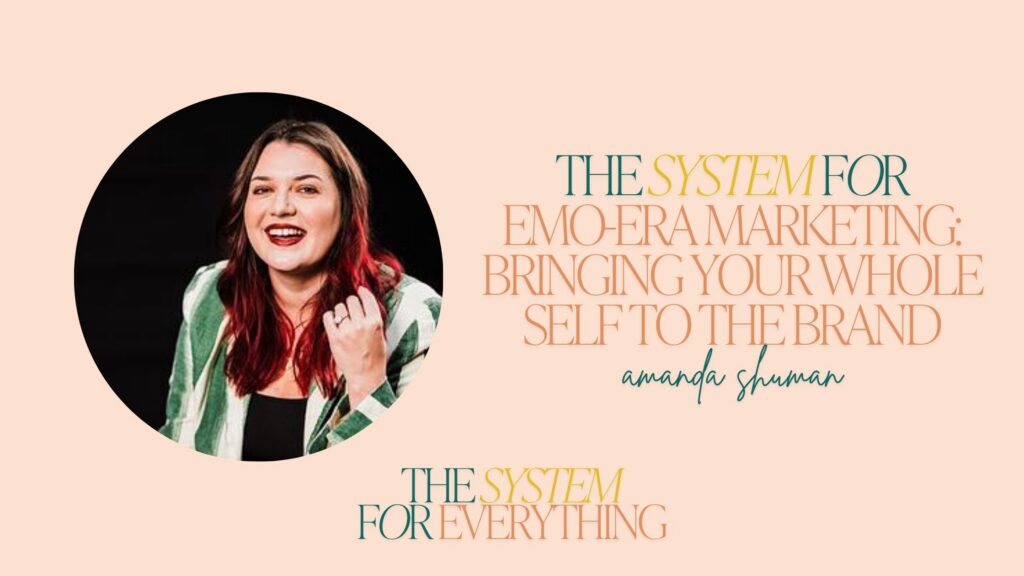
If your brand has ever felt like a bad haircut you can’t grow out fast enough, then this episode is for you. There comes a point in business where what once felt exciting starts to feel off or indifferent. While it’s not necessarily wrong, it feels disconnected. That feeling isn’t a sign that you’ve failed—it’s often a sign that you’ve grown.
Today, I’m sitting down with Amanda Shuman, founder of Carrylove Designs, to talk about what it really means to build a brand that evolves with you. From emo-era MySpace profiles to motherhood, pivots, and public reinvention, we’re unpacking how your personality isn’t a distraction, but instead it’s your strategy. What I love most about this conversation is her honesty about what happens when your business no longer feels like you and how to rebuild without losing yourself in the process. That’s called personal branding for business owners.
Review the Transcript
Julie: Welcome back to the System for Everything podcast. Today’s system tip if your aim away message once included, dashboard confessional lyrics. Congratulations. You’ve been marketing with emotion since 2003. Today’s guest is one of my very favorite people, Amanda Schumann. She is the owner and founder of Care Love Designs.
She’s a speaker, podcast host, award-winning designer and marketing strategist her age. Agency Carrie Love Designs is an agency specializing in strategic branding for B2C companies in luxury service and boutique product industries. She and her team craft brands that do more than stand out, they elevate her work has helped clients attract high value audiences, grow their revenue and hit milestones with confidence.
Amanda’s strategy first Approach has earned her a seat at the table with industry leaders. From podcast interviews to keynote stages nationwide based in Texas, Amanda is fueled by life’s little luxuries, traveling with her husband and two kids, and finding inspiration wherever she goes. Welcome, Amanda.
Amanda: I am so glad to be here.
This is gonna be so much fun. I can already tell by your intro, not about me, about the dashboard, confessional lyrics.
Julie: Yes. I think music, love of this type of music and you know, who we were at circa end of high school is something that we bonded over. We met, I wanna say maybe three, four years ago now. And I thought, I did not know who you were before we met at Brandy’s conference.
Amanda: Mm-hmm.
Julie: And I thought you were like elite, cool girl. And I was like, oh, I wanna go be friends with her. Oh my God, I wanna sit by her. And so. In true Julie Fashion, I like made you become my friend.
Amanda: There you go. No, uh, same. Likewise. I can’t believe that’s only been three or four years. It feels like way longer.
Julie: Yeah, for sure it does. All right, we’re gonna start, as we always do with the system, reboot. A quick reset to start our episode with some humor and humanity. What is your go-to snack or drink when you are designing or working for a client who still is saying make the Lego begar?
Amanda: Oh man. I’m not much of a snacker at my desk.
I try not to eat at my desk, but. Ops are definitely my beverage of choice. Either that it usually starts out as like a London fog or mud water in the morning. I don’t, I don’t drink a lot of caffeine. I don’t
Julie: What is Mud Water?
Amanda: Mud water is, it’s a brand and it’s kind of like. Um, before mushroom coffee, it’s just supposed to be like healthy for you.
It has a whole bunch of stuff that I can’t pronounce, but it’s like natural to the earth.
Julie: Okay. It, but is it like mushroom coffee where it has like caffeine or it just is like
Amanda: No, it doesn’t just hydrates you Doesn’t have, yeah, it doesn’t have very much, I wanna say it doesn’t have very much caffeine, if any at all, but it has.
Things in it, like lion’s mane and things that that’s going to like naturally caffeinate you or make you feel like energetic. But yeah, it’s called mud water. Look it up. I’ve been using it for years now. And then if not, like I said, a London fog. And then I transitioned into an op.
Julie: All right. What was your aim, screen name?
And would you use it today as a business name?
Amanda: No, I would not. Uh, my, this is so funny. My screen name was Jaws, um, 5 9 3 1. Jaws was my cat. And. We named the Cat Jaws because it was not a friendly cat. Um, this was a cat where you’d be like, you know, going to pet it and just be like, he, and like run away from you.
So Jaws and then 5 9 3 1 was my lunch number at school. So
Julie: my first screen name was Spirit qt. 89 ’cause I did cheer and the 89 I just liked. ’cause that’s not my birth year. Like I’m three years older than that. But my screen name throughout, uh, high school and into college, I honestly think I could still use it as a business name.
I mean, it would be silly and I’d get made fun of, but it was Julie like, whoa.
Amanda: Oh, is Zach. What is that all time low that you gotta love? Like, whoa, whoa. Oh no, girls gotta love, like, yes. Yeah, yeah. See, I’m down. But
Julie: I feel like it’s like, you know, just like Julie with a bunch of exclamation points and like, I feel like that’s like, that’s like my brand.
Amanda: Yeah. Yeah, it’s definitely way better than Jaws 5 9 3 1.
Julie: All right. What is a movie or TV character you secretly base your CEO Energy on?
Amanda: Oh, the first one that comes to mind. Well, if you’ve been around for a while, then I always talk about, uh, Jenna rank from 13 going on 30. So that’s the first one that comes to mind.
But then also, I’m not like a girly girl, but legally blonde. Like the way that she just showed up in like, yes. Was so organized and just took care of business,
Julie: I think you can match that energy without having to match the clothes.
Amanda: Okay, okay. Yeah, it would be a mixture between both of both of them.
Julie: Okay. I love that.
All right everyone. You have met the personality. Now meet the powerhouse. Today we are diving into what it means to show up as the full version of yourself, MySpace roots, mom, brain, and all, and how that honesty doesn’t weaken your brand. It becomes your brand. Here’s my conversation with Amanda on the system for Emo era marketing, bringing your whole self to the brand.
All right. I wanna start with something that so many people like, feel, but don’t really like talk about is what happens when the business that you have built starts to feel like a bad haircut, like complete with mistake bangs after a breakup.
Amanda: Mm-hmm.
Julie: Like it’s just not you anymore.
Amanda: Yeah. Yeah. This definitely was something that.
I was feeling probably about 18 months to two Man, two years ago. I, yeah, 18 months, two years ago, where the first thing that I noticed is that I wasn’t proud of it anymore. Mm-hmm. Like there was just this gut feeling, not, not that I didn’t, not like my website, is the first thing that I think of. I didn’t not like it anymore.
I just didn’t have that. That proud moment of when I shared it, I had lost that, that kind of spark, I guess you could say. And so that was the first thing that I noticed. But then usually I really feel like there’s just this gut feeling that we have around our brand where there might not be one particular thing that you can set, you know your finger on, but there’s just this, this gut feeling,
Julie: what is it?
It feel like to pivot in public, especially when you’ve really been known for something specific like you were for branding for Wedding pros.
Amanda: Scary.
Julie: Yeah.
Amanda: Yeah. Pivoting in public is is hard, but mainly because the question that I kept asking myself is where do I tell people about it? And then where do I just kind of build?
In the background. Mm. Like what do I say out loud and bring people along on the ride for versus what am I just doing on my own? And like nobody needs to to know because, you know, you still wanna show up as an authority figure. And I don’t ever wanna come and say like, Hey. This is what I’m doing and I don’t have it figured out yet.
Like usually whenever I show up personally, I wanna say, this is what I’m doing and this is what I’ve learned so far. Not that I have everything figured out, but this is kind of what I’ve learned. Instead of just being like, you know, opening up a door to a messy closet and being like, here’s everything. So that’s the biggest piece for me because I don’t want to lose that like authority figure of like showing up and having some value to give.
I mean, there’s um, a business owner that I have followed for probably a decade, if not over a decade, and she has had so many different pivots and eras along the way that after a while I, I did quit, like following her because she was just showing up and it felt like. Trendy or following the next thing.
Mm-hmm. Or just chasing the money instead of really, you know, asking yourself the, the hard questions and pivoting with a, a purpose other than money.
Julie: How do you handle that fear that people won’t follow you into the next version of your business?
Amanda: I really wish that I had a better answer to this
because my answer sucks. Uh, putting one foot in front of the other, doesn’t that sound so bad? But that’s really, honestly, no,
Julie: I, you know what? It’s cliche, but it’s cliche for a reason, because it works and sometimes it’s the best thing you can do one day at a time, baby.
Amanda: Yes. Honestly, that’s, I was like, I wish I could say something better than this, but really like one foot in front of the other is, is my advice.
And don’t think about it too much. You just gotta keep moving.
Julie: Yeah. Sometimes letting go of what has been working for you is the scariest part, but it can also be where the magic starts.
Amanda: And it did bring up this point of when does. Perfectionism because I think that’s what hangs up a lot of people, is they don’t want to talk about, or they don’t want to launch something until it feels perfect.
And when does perfectionism turn into pride?
Julie: Ooh. Oh, that’s good.
Amanda: So I don’t have an answer to that, but, but that is something that I, you know, have worked through is like, when am I, you know, when do I want something to be perfect? But when is it turning into just pride?
Julie: I think we’ve all heard, you know, like it’ll be authentic like a million times over, but what does that actually look like when you’re building a brand?
Because not everything needs to be shared, but like some things should be. So how do you guide clients in figuring out what. Parts of themselves belong in a brand.
Amanda: I will say that this is a lot easier to do for somebody else than it is yourself. Like there have been so many times that even I have like texted you or texted other people and I’m like, how would you describe me?
Because I see myself one way, but I’m not sure if that’s how other people perceive me.
Julie: Yeah.
Amanda: It’s a lot easier whenever you do, you know, have an outside person to even, you know, bounce ideas off. Or if you’re working with them professionally to kind of work through some of these things that it makes it a lot easier.
But one of the questions that we always ask our clients is about values and. What you value in bringing that into, and it can be something as silly as music. Like Music in my family is something that we really value. There is, I have Alexa on, we have a, oh my gosh, what’s the, I’m blanking on the name of it.
Julie: Boombox. No, walk, man.
Amanda: No, you put the needle on it.
Julie: Oh, a record player.
Amanda: Record player. Why could I not think of that word? I could like see it and I’m like a record player. My gosh. A record player, like my daughter.
Julie: That’s really hoping it was a lockman.
Amanda: I mean, we might bring that into the mix too, but something as simple as music to us, that is something that I value as a person and we value within our family.
And so I brought that into my brand. Um, and so you don’t have to au automatically think like. Something very philosophical.
Julie: Yeah.
Amanda: But it can be something that you’ve, that you truly value in your everyday life. Because what makes it hard is whenever you say, oh, well, I’m gonna make this a part of my brand, but you don’t ever do it in your everyday life, or you don’t show it, then it’s hard to bring that into your brand whenever it’s not really a part of you know, who you are or how you live your life.
Julie: If your business couldn’t run without you. That’s a problem, a haunting your assistant from the beyond kind of problem. Enter the entrepreneur’s death folder. It’s your digital contingency plan. Think of it as the world’s least spooky survival guide for your business. All your logins, contacts, workflows, and need to knows in one tidy place because peace of mind is the ultimate productivity tool.
Grab yours
Amanda: today@dallasgirlfriday.com. Before life throws a plot twist.
Julie: What are some kind of subtle ways to bring that personality into your brand without it feeling forced or performative?
Amanda: Okay, let’s take, give me something where you’re, whenever I was talking about value, you’re like, this is something that came to mind for me.
Julie: Oh, loyalty.
Amanda: Loyalty. Okay.
Julie: Yeah.
Amanda: So we’re going more, more philosophical with loyalty
Julie: or I would say like maybe sense of humor. Like that’s one of my biggest things, like,
Amanda: okay, we’ll
Julie: get back to it. And I value within my own brand.
Amanda: We’ll get back to sense of humor, but along with the loyalty, because that automatically makes me think of something for you to where, and this even came out whenever we did, your brand is cheerleader.
Like you are always being like very loyal to your friends and supporting them and doing whatever you can to uplift them.
Them
Amanda: their
Julie: Yes. Spirit, QC 89. It all comes back around.
Amanda: So that is how you’re showing that within your, your brand, it’s something that you really value as a person, and we are seeing it play out within your brand.
Julie: Yes. I love being a hype girl. A hundred percent.
Amanda: Yeah. And then sense of humor, I mean, we also see that within your brand, the way that you show up on stories, the way that you run this podcast like that to me. Is authentic because you’re already doing it within your brand without having to think about it because you truly value it.
Julie: Do you think that there’s a difference between branding with personality and just branding for attention?
Amanda: I. Yeah, and I think that goes back to the same, that same word of authentic, like if you are branding with personality, it’s because that’s who you are and how you’re showing up in the world and like,
Julie: yeah,
Amanda: being, you know, quote unquote authentic to yourself.
But branding for attention is more like trendy, like just doing something for, to get the likes and the mentions and comments and stuff. To me, in my head, that’s what I think about whenever branding for attention.
Julie: Mm. Yeah. You don’t need a, a viral video or like a shocking confession post. You just need to like stop sanding down the edges of what makes you different.
I wanna get into kind of the fun part of it all. ’cause it, it turns out I think that maybe our, our inner emo kids might have been our first branding coaches. So what, what parts of your emo era, you know, music mindset, fashion still show up in your business today?
Amanda: Girl, you know it was never an era, like
Julie: just your life.
Amanda: Yeah. It’s still happening. Was
Julie: kind of life era.
Amanda: I will tell you, I started this kind a little bit off topic, but maybe not. I started wearing Converse. Seventh grade. I wanna say before it was like, cool. And I wore them literally. Okay. If we’re gonna get real personal here, I started wearing them because somebody made fun of my toes.
They, I had, I had long toes. I, I mean, I still have long toes and so I was like, I am never showing my to toes,
Julie: long toes, like a sign of intelligence or something. I, I mean, I think I just made that up, but let’s pretend it is.
Amanda: Yeah, we’ll go with, we’ll go with that. And so I started wearing Converse every single day.
Still wear them to this day, not every single day. I, I show my toes now, but, but I started doing that before it was cool. And I remember being so upset whenever we got to, like, maybe freshman year of high school in Converse became like, cool. And so all the popular girls and stuff, I was like, you don’t even know what Converse means.
Like it’s not even your way of life. Um. So that, I think that was off topic, but that’s what, that’s what I
Julie: really, really loved it. It’s not even your way of life. I love that. Okay. If we were to open up your old MySpace page, what do you think from it would still hold up?
Amanda: I think honestly, all of it would still, I would, I have tried so many times to go back and see if I can find my MySpace page.
Does see if it’s like still there in existence. I have
Julie: not tried to do that, but I did try to find my Zenga, I mean, and My Life Journal.
Amanda: Nope. Never had one of those.
Julie: And oh my God,
Amanda: I,
Julie: I was really into Life Journal, but I, I don’t know what the password is and it’s like connected to an old email address and so I, I can’t get into it.
Amanda: Yeah, that’s probably what would happen to my MySpace. But I would say, I think that it would still hold up today. I mean, I would spend hours, you know, curating everything from the background to the music to your top friends. Oh, yeah. Taking, taking all of the like quizzes or whatever that you’d post like in the notes section.
Julie: Oh, the quizzes were my favorite. And I think that that kind of speaks to this podcast too, because it was like, I’d loved reading, like, Ooh, who was the last person you texted? Yeah. What was the last TV episode you watched? And like all of that, like, I’m still very into, I wanna
Amanda: know. Yeah. Yeah, so I think it would still hold up.
Maybe that’s wishful thinking.
Julie: How do you think that music has helped you tap into the emotional storytelling or stronger content within your, your own brand messaging or the way you help others figure out their brand messaging?
Amanda: If you think about. Music and they’re, they’re called artists. Like, yes. If you think about artists, like they are literal artists with music in the way that they perform at shows and the storytelling and the promotion.
Like for me, I love studying. How bands, you know, come out with singles in their albums and how they promote their tours and they’re just masters at what they, what they do. And so I really, you know, tap into how they are promoting things and the storytelling that they’re showing because they’re, I mean, they’re, they’re artists at it.
Julie: I think there’s really something special about seeing like what other people could. And refer to as cringey interests, like become part of your core identity and realizing that like those are the things people remember. One of the, the biggest changes that came into play for me, and I know many people out there, motherhood, it changes everything.
And for a lot of creatives, the question becomes, how do I honor this new version of myself without losing what I have already built? How did becoming a mom change the way you think about your time, your brand or your values?
Amanda: I really, so going back to thir, the movie 13, going on 30, if you know my journey, I, I thought like for sure I was going to go to New York and work for like a big ad agency or a magazine or something like I thought that we would’ve met there.
Anyway,
Julie: I was gonna be there winning a Tony, so,
Amanda: oh, there you go. So. I really thought that corporate America was going to be my, my life. Um, and after having Cadence, cadence is my daughter. That really changed everything for me because I would wake up at, uh, like five 30 in the morning, get ready for work, get her up, get her ready for daycare, you know, drive.
An hour, hour and a half round trip, like dropping her off, then getting to work and by the time I would get home, you know, get off at five o’clock, do the whole thing again, get home at six 30, and then basically eat dinner and go to bed.
Julie: Yeah.
Amanda: And I was like, I can’t, like somebody else is raising my kid at this point.
And so that’s whenever everything really shifted for me and it shifted in my attitude and the way that I was showing up. Um. That I, if you don’t know, I eventually ended up getting fired from my corporate job, and it was because of, you know, my daughter and she ended up getting sick and they couldn’t figure out why, and I couldn’t take her to daycare.
And after that, that’s whenever I told my husband, I was like, uh, can I not go back to corporate America? Like, I think I wanna do, uh, CLD carry love designs. I, I think I wanna do it full time. And so, really, CLD was. Officially started after Kay was born and she really gave me the drive to want to show up and turn it into, you know, business and be serious about it.
Julie: Are there any brand elements that you’ve retired or maybe leaned into more since becoming a mom?
Amanda: Honestly, like one of the, you talked about cringe earlier and like one of the cringe words for me is mompreneur and like showing up and like
Julie: that’s fair.
Amanda: To me, I’m like, whenever I step into, you know, a business owner role or I go to a conference to speak or whatever, yeah, I’m still a mom, but they don’t have to coexist at the same time.
Like me speaking up on stage doesn’t like me being a mom doesn’t change how I show up on stage. Um, yeah. And we don’t see men doing that. They’re not like dad entrepreneurs or anything.
Julie: Yeah.
Amanda: Like
Julie: nobody has ever said, dad, entrepreneur. It’s ridiculous.
Amanda: And actually I was just talking to my husband about this this week.
’cause you know, we were talking about, I’m traveling for speaking engagements and stuff and I said I am independent and I don’t want my whole life to revolve around being a wife and a mom. Like of course those are big, huge pieces of my, my life. But I’m so glad that I still have an identity outside of those things, and they haven’t become like my whole entire life
Julie: a hundred percent.
What systems or habits have you have have helped you stay visible while continually navigating that life shift?
Amanda: I can’t say that I’ve stayed visible and done the best. I think that there are times where, you know, I’ve wanted to be more introspective and kind of like, I’m gonna go, you know, going back to the artist, I’m going to like go write all of my songs and, you know, do stuff away from the public.
And so I haven’t always stayed, stayed visible, but. I think no matter how long that you’re away, whether it’s a week, a month, a year, just like showing back up and jumping in without missing a beat is really helpful. You know, whenever people,
Julie: yeah,
Amanda: quit doing something for a week and they’re like, Hey, you might have missed me.
I was gone and I’m like, don’t. Don’t tell people that. Just come back. Just come back. Yeah, just come back. Don’t make it a big deal.
Julie: Yes. Yeah, you can definitely grow your business and be growing offline as a person at the same time. Yeah, it just takes intentions and, and boundaries. Yeah. And maybe the occasional email playlist.
Amanda: Absolutely. Those never left.
Julie: It’s true. Guys, we gotta make a playlist for this episode. We’re, we’re gonna do, I’m gonna do it. We’re we? There will be a Spotify playlist for this episode.
Amanda: Love it.
Julie: All right, Amanda, tell everyone where they can find you online and how they can work with you.
Amanda: Um, you can find me online at Carry Love Design.
So it’s carry as in like the verb to carry. It means to carry love throughout everything that we do of like, you know, the people that we meet, the work that we do, the people that, you know, we work with. Um, and so it’s C-A-R-R-Y. Carry love. Um, but you can find me@carrylovedesigns.com. I have been really focused on growing my personal Instagram, so if you want to follow me at the Amanda Schumann, um, it’s S-H-U-M-A-N.
You I’m, we’re also on Instagram Carry Love Designs as a well, but it’s gonna be more of our portfolio work in. The number one thing if, if you want to do an audit, if you’re like, Hey, I would really love to know like how my brand should be showing up. I, you know, get that gut feeling and I don’t know exactly what is off, but I still want to continue growing my brand, then the audit is going to be the best place for that.
If you go to our website and scroll all the way down to the footer, you’ll see, um, a button for, it’s called a clarity audit, to give you clarity around like what your next steps are, and to basically give you a roadmap. And for all of the listeners, if you put in the promo code, it’s a self-checkout, um, situation.
And if you put in the promo code systems, you’ll get a hundred dollars off your audit.
Julie: We will have all of the, uh, details in the show notes as well, everyone. All right. Before we close things out today, I’d like to end with a little chaos business style. Uh, so it’s time for the system shut down. Today is gonna be a rapid fire themed list to remind ourselves that yes, this is all made up and yes, we’re still doing great.
Okay, Amanda, you are up. First, I want you to give me your five songs. From your teen years that accidentally became business anthems and then I’ll share mine.
Amanda: Okay, so I broke the rules a little bit. They’re not all from my teen years because
Julie: Well, don’t even bother then if you broke the rule. No, I’m just kidding.
Please go.
Amanda: They’re just not, I will start off with, are we doing one at a time and like going back and forth like one and then you do one.
Julie: Oh, we can, yeah. I’ve never done it like that, but we can do that. Yeah.
Amanda: Okay. Okay. My first one is Take Me Away By Lash, if you remember Freaky Friday.
Julie: Yeah,
Amanda: that would be my first one.
It’s, you know, whenever you’re feeling like bossed around and like you get that teenage angst inside of you, that’s a great, once a Blair. All
Julie: right. My first one is I woke up in a car by something corporate for when you are chasing a dream that is half brilliant and half delusional and 100% yours. You know the campaign didn’t convert the client.
Ghosted. Still, you’ve built a business that can go anywhere.
Amanda: Oh, okay. Okay. My next one probably nobody has heard of. If you have heard of this song, then message me on Instagram so that we can be in a fan club together.
Julie: Uh,
Amanda: it is by a band called La Bouquet, and the, the song is called Life’s a Lot, and basically it talks about life being a lot and, but it’s still precious.
Like even whenever you’re going through hard times, like you have to remember that life is still short and precious.
Julie: Aw, I love that. Okay, number two on my list is swing life Away by Rise Against. For those quiet afternoons when you’re catching up on bookkeeping or ordering labels and remembering that simple can still be sacred.
Oh, we live on front porches and design in back rooms, and that counts. Okay.
Amanda: Okay. Okay. Um, the next one that I have is in my house. My kids asked me to play this song, especially my 4-year-old Sean is known as the DA song. It is the downfall of us all by a day to remember. Um, and it’s about the pressure in like making people happy in like fame versus staying true to yourself.
And so if you ever feel caught up in those moments, that’s a good one to Blair.
Julie: I love that. Number three for me is my friends Over You by newfound glory, uh, for when a client tries to micromanage you. And do you remember? You don’t have to say yes anymore. It’s not me. It’s you. It’s you. And I choose my people and my peace.
Amanda: I choose my peace. I love that. My next one, this one is not. So the band is definitely from my teenage years, but this song specifically is not, it’s one of their newer songs, but it’s Headspace by the used. This one’s a dark song. If you listen to this, you’ll probably be like, what the heck, Amanda? Um, but it’s about like emotional pain and like.
People wanting you to change even whenever you can’t, and so it’s a really good song. The lyrics are like Chef’s Kiss, but it’s definitely a darker one.
Julie: All right, my number four is in this diary by the Ataris for every Note app rant, back pocket business idea or event session that later becomes content.
Gold. Being sentimental is a strategy when it helps your audience feel something.
Amanda: I love that. Okay. Okay, and since the last one, Headspace was a little bit, if you listen to it, like I said, it’s a little bit heavier. I ended on a light note, one of my all time favorite bands, yellow card. And the song is Lift A Sale, um, which is about overcoming and moving forward and just like moving past something in your life.
Um, one of the lyrics that I probably will get tattooed on me someday says, life is just too sweet to lie in this defeat. Oh,
Julie: oh, I love that. All right. My final one is like a movie by Midtown. For those moments when everything just clicks and you think maybe this is the montage where it all works out. You know, you don’t need a film crew, you just need a messy desk.
A working mic and a little main character energy. All right, everyone. That is it for this episode of the system. For everything. You don’t need to be cooler, quieter, or more professional to build a brand that connects you just need to show up with those edges still intact today, Amanda reminded us that personality is strategy and your weirdness.
Might just be your winning move. If this episode made you laugh, think or dig your iPod nano out of storage, leave us a review on Apple Podcasts or Spotify. It really does help. New listeners find the show and come find me over on at Dallas Girl Friday on Instagram. Thanks for listening. See you next week.
This episode is brought to you by The Entrepreneur’s Death Folder:
If your business couldn’t run without you, that’s a problem—a haunting your assistant from the beyond kind of problem. That’s where the Entrepreneur’s Death Folder comes in. It’s your digital contingency plan: all your logins, contacts, workflows, and need-to-knows in one tidy, shareable place.
Less spooky, more smart. Because peace of mind is the ultimate productivity tool.
Signs Your Personal Brand No Longer Reflects Who You Are
One of the earliest signs of misalignment in personal branding for business owners is a loss of pride in the brand. It’s not necessarily that anything is objectively “wrong,” but something feels missing. The excitement of sharing your work fades, and the connection you once felt to your brand starts to weaken.
This shift is often subtle, which is why it’s easy to overlook. Amanda sees so many business owners waiting for a tangible reason to make a change, like a new offer, a new audience, or a clear external trigger. The most important signal is often internal—like a gut feeling that something is off is worth listening to, even if you can’t immediately explain it.
When that disconnect lingers, it impacts more than just how you feel. It affects how you market, how you communicate, and how your audience perceives your brand. Alignment in personal branding isn’t just a personal preference—it’s a strategic advantage.
The Reality of Pivoting Your Business in Public
For Amanda, one of the most challenging aspects of evolving her brand wasn’t the decision to pivot—it was figuring out how to do it publicly. There’s a natural tension between wanting to bring your audience along for the journey and wanting to maintain your authority. One of the biggest questions she got curious about was what to communicate openly versus what to build privately. Sharing too much, too soon can feel like exposing unfinished work, while sharing too little can leave your audience confused about where you’re going.
How to Pivot Your Personal Brand Without Losing Authority
Amanda’s approach is rooted in intention. Instead of documenting every messy step, she focuses on sharing what she has learned along the way. This allows her to show up with value and insight, rather than uncertainty, while still evolving in real time.
Letting Go of What Used to Work for Your Brand
One of the most difficult parts of growth is releasing what once worked. Amanda speaks candidly about the fear that comes with leaving behind a version of your business that was successful, even if it no longer feels aligned.
There’s also the very real concern that your audience won’t follow you into the next chapter. And while there isn’t a perfect solution to that fear, Amanda’s perspective is refreshingly simple: keep moving forward. Sometimes the most effective strategy isn’t overthinking every step—it’s continuing to take action, even when the path isn’t fully clear.
This is also where she raises an important question: when does striving for excellence become perfectionism, and when does perfectionism turn into pride?
Waiting until everything feels flawless can keep you stuck longer than necessary, preventing you from stepping into the next phase of your business.
What Authentic Branding Actually Looks Like
Authenticity is often treated like a buzzword in marketing, but Amanda approaches it from a more practical perspective. For her, authenticity isn’t about sharing everything. You need to build a brand that reflects what you genuinely value.
One of the ways she helps clients uncover this is by focusing on their everyday values. These don’t have to be abstract or overly philosophical. In fact, some of the most impactful brand elements come from simple, personal things that already exist in your life.
The key is consistency. If something is truly important to you, it will naturally show up in how you live, work, and communicate. When your brand reflects those real-life values, it becomes easier to create content, connect with your audience, and maintain a sense of alignment.
Subtle Ways to Infuse Personality Into Your Brand
Amanda draws a clear distinction between branding with personality and branding for attention. While both can generate visibility, only one builds long-term connection.
A personality-driven brand feels natural because it’s rooted in how you already show up. It doesn’t require constant effort or reinvention. Instead, it shows up in the tone of your content, your sense of humor, and the way you engage with your audience.
Branding for attention, on the other hand, often relies on trends or tactics designed to capture immediate engagement. While it can create short-term results, it rarely leads to meaningful connection or trust.
According to Amanda, the goal isn’t to chase attention, but instead to build recognition. That comes from consistently showing up as yourself, rather than trying to fit into what’s currently popular.
Why Your “Cringey” Interests Are Actually Strategic
Some of the most memorable parts of your brand are often the things you’re tempted to downplay. Amanda highlights how personal interests—like music, humor, or even nostalgic references—can become powerful tools for connection.
These elements give your audience something to relate to on a deeper level. They create emotional resonance, which is often what makes content stick. In a crowded digital space, being memorable is more valuable than being perfectly polished.
Amanda often looks to artists, particularly musicians, as an example of this. The way they tell stories, promote their work, and create experiences for their audience is deeply intentional. That same level of intentionality can be applied to how you show up in your own brand.
Evolving Your Identity Without Losing Yourself
As life evolves, so does your brand. Amanda shares how major life shifts, like becoming a parent, can influence how you approach your business, but they don’t have to redefine it entirely.
For her, it became important to maintain an identity outside of any single role. While personal experiences naturally shape your perspective, they don’t have to dictate how you show up in every aspect of your brand. This creates space for both growth and independence.
She also emphasizes that visibility doesn’t have to be constant to be effective. There are seasons for building privately and seasons for showing up publicly. When you return to visibility, you don’t need to over-explain your absence—you can simply continue forward.
The Real Strategy: Stop Sanding Down Your Edges
If there’s one idea Amanda reinforces, it’s this: your brand doesn’t need to be more polished. It simply needs to be more honest.
The instinct to smooth out the parts of yourself that feel different or unconventional can actually make your brand less effective. Those “edges” are often what make you recognizable, relatable, and memorable.
You don’t need a viral moment or a perfectly curated presence to grow your business. You need alignment, consistency, and the willingness to show up as you are—without over-editing the parts that make you stand out.
In the end, the brands that resonate most aren’t the ones that feel the most perfect. They’re the ones that feel the most real.
Find It Quickly:
- 2:01 – The System Reboot
- 6:01 – When Your Brand Feels Off
- 7:20 – Pivoting in Public
- 10:36 – Authenticity and Values
- 13:26 – Personality Without Attention Chasing
- 15:36 – Emo Era Branding Lessons
- 19:40 – Motherhood and Identity Shifts
- 23:11 – Staying Visible With Boundaries
- 24:29 – Where to Find Amanda
- 25:56 – System Shutdown Song Anthems
Connect with Amanda:
- Website: carrylovedesigns.com
- Instagram: instagram.com/carrylovedesigns
- Instagram: instagram.com/theamandashuman
- Clarity Audit: carrylovedesigns.myflodesk.com | Use code SYSTEMS for $100 Off