




Delegation is often misunderstood in the entrepreneurial world. Many business owners associate hiring help with losing control, adding stress, or spending money without real results. If you’re asking whether you should hire, you’re probably already overdue. And not just hire… hire with intention.
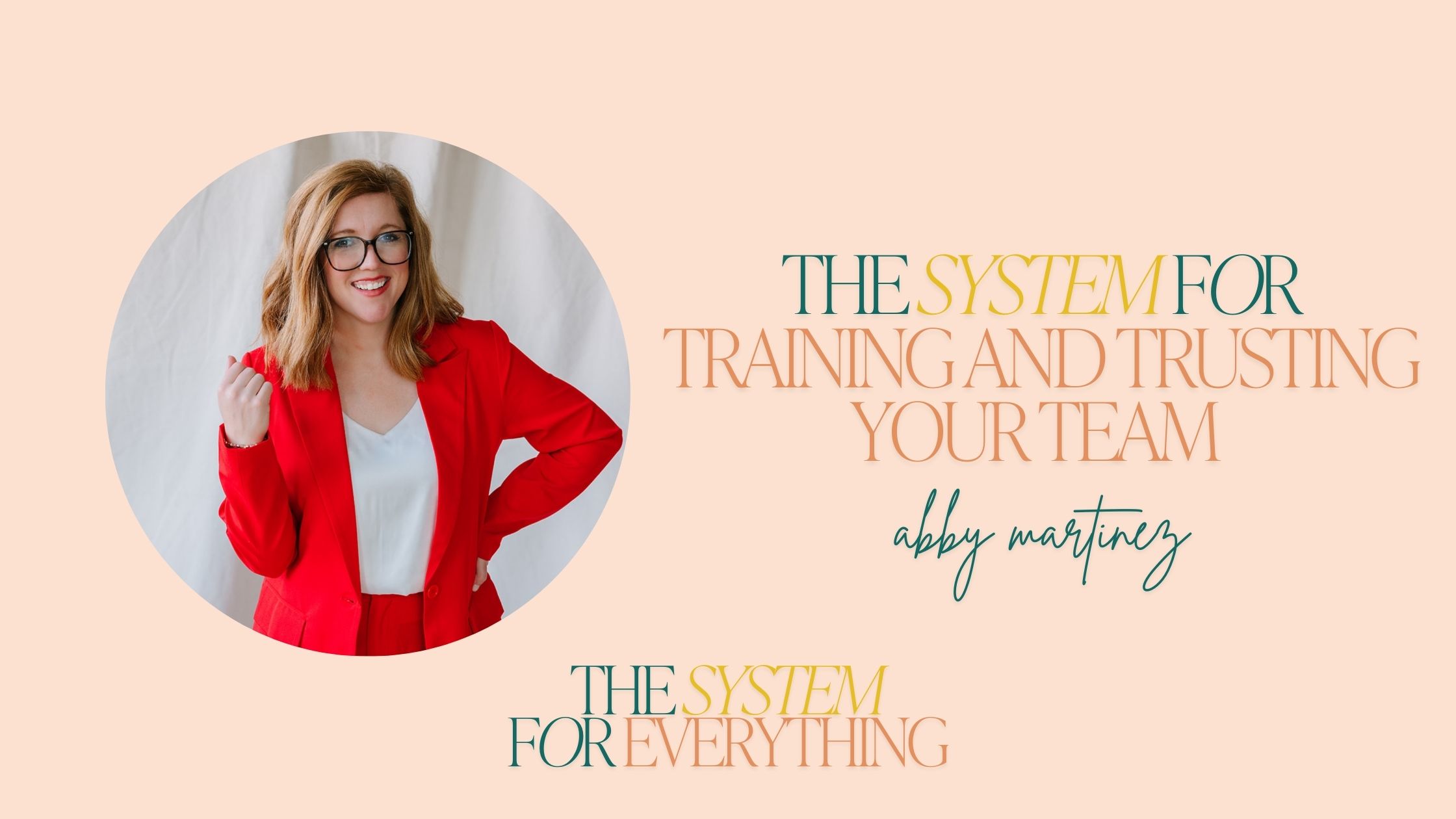
This week, we’re joined by Abby Martinez to discuss how you can train a team that you trust. She’s a mom of two, a certified coach, and a systems nerd who believes structure creates freedom — and she’s here to tell us how to hire, train, delegate, and keep things running smoothly without burnout.
Review the Transcript:
Julie: Welcome back to the System for Everything podcast. Today’s system tip. If your to-do list says, just do it. You are not delegating, you’re panicking with the Nike slogan. My guest today is Abby Martinez, the founder of Well-Balanced Business and Agency that supports entrepreneurs with virtual assistant and online business management services so they can finally step out of the day to day and lead their business with more clarity and.
Ease with a background in education and a love for systems that actually work. She’s grown her team into a multi-six figure agency while staying rooted in what matters most. Integrity, aligned leadership and building a business that supports your life, not the other way around. She’s also a mom of two, a certified leadership and life coach, and a big believer.
That structure creates. Freedom. Welcome, Abby. Thank you so much for being here today.
Abby: Thank you so much for having me, Julie. I’m so excited.
Julie: All right. Today, we’re gonna start, as we always do with the system reboot. We’re gonna get into it with a quick little reset to start our episode with some humor and humanity.
Abby, what fictional character would you call to help you clean out your inbox?
Abby: Oh, to clean out my inbox. Oh man. I thought we were gonna say like to, I don’t know, you know, like something more, something different than that. I love this. So to clean out my inbox, I dunno, maybe like the little mice from Cinderella.
Oh my God. Gus Guss would be so good at it. Yeah. He would not
Julie: stop until it was perfect. Yes, exactly. That’s a one. Sorry, what? What is a scent that makes you irrationally happy?
Abby: Oh my gosh. Pumpkin. Like pumpkin candles. Ooh. I mean, I’ve already been lighting mine. They’re so good.
Julie: I mean, I don’t care what time of year it is.
I don’t care if it’s burning hot outside. I love a full scented candle. I totally agree with that. The best. Yep. And what is something totally unserious that you are currently obsessed with?
Abby: Oh, totally unserious. I don’t know if this consider is considered unserious, but I’m very obsessed with paddle waring right now.
It’s been like my summer. I love that. Like hobby. It’s been so fun.
Julie: I 100% would fall off immediately. No, I, no, I don’t even think I could get up. I, no, I don’t even think I could get on my No way. I think you could. Yeah, I think people like make it out to you. That’s how I died.
Abby: Yeah. Probably That’s how I die.
I think people think it’s harder than it is. I totally believe you could do it. Julie.
Julie: Oh my God. Thank you so much for that blind and incorrect faith in me. All right everyone. You have met the personality. Now meet the powerhouse. Let’s get into the real system of the day because growing a team doesn’t have to mean growing your stress.
Abby is here to show us how she gets things off clients’ plates. Without watching them crash to the floor. Here’s my conversation with Abby on the system for training and trusting your team. Alright, so let’s start at the beginning. You know, before the trust, before the training, there’s the hiring. Yes.
When do you know it’s time to hire and what kind of roles come first?
Abby: Great question, and I absolutely love this question, and I will say that if you’re asking the question of Should I be hiring, you probably should be hiring. I feel like that’s commonly the conversation I have with people is like, I need.
Help and I need it yesterday. So if you’re in that place, it’s a good time to start assessing like what is stressing you out the most. And so one of my favorite ways to look at this is super simple. So I call it your yes list. And on the flip side of that, your no list. So you start to collect kind of, you know, throughout your day, um, and throughout your week, what are the things that you absolutely want to be doing.
And actually need to be doing in your business, and then everything else that you’re like, oh, I don’t wanna do this and I actually don’t need to be doing this. That goes on the side that says no. And that is kind of your starting point for figuring out what do I actually need help with? What is going to make the biggest impact in getting off of my plate?
So that’s kind of where I always tell people to start when they’re looking at bringing someone on. There are of course, other things that go into it, like looking at your. Finances and, you know, making sure you’re in a good place. But I think most entrepreneurs can even bring on just a small little bit of help.
You know, even just a small little bit of help really, you know, gets you going kind of a little bit further and gets you back into your zone of genius. Um, so that’s kind of the starting place. And then based on that list you can decide, is it, it kind of depends on what ends up on that no side, like is it admin, is it.
You know, social media, is it what is really draining you? What is stressing you out? And the second question I asked before you hire people is, what can you automate? So looking at that list and deciding, is there a system that I can create, that I can automate some of this, or to make it more efficient, and then bring in people, whether that’s you’re hiring someone to set up these automations for you, whether it’s you’re setting up a system and then bringing someone in to manage that system.
I always think it makes sense too. Try to see if there’s ways to make it more efficient through your systems and through automations before just hiring someone to come in and do something that maybe needs to be set up first a little bit.
Julie: Absolutely. Okay. So what does onboarding look like when someone joins your team?
Yeah, I mean, are there trainings, manuals,
Abby: shadowing? Yeah, great question. So for our team, uh, we hire those who have either already been trained, so we have OBMs and VAs. So our requirement is, is that you have, for the OBM side, that you’ve gone through like an OBM certification or for the VA side, that you have some sort of experience.
You’re not coming in like a. Without, you know, having really any sort of idea of what the online space is and what we do. Yes. And so from there, we will bring the person into our team. We have like kind of a kickoff call. We share, you know, our vision, our mission, all of that with them. You know, they introduce, uh, to the other team members.
And then internally we have a whole training vault that they can access as they’re working with clients. Our clients have such a wide variety of needs. We are. We kind of serve in a lot of different ways, both admin and creative is how I typically describe it. And so when our clients come in, they’re actually paired directly with a team member.
So we don’t have a hierarchy where unless you’re working with an OBM and a va, there’s not really a hierarchy where you’re coming in working with a case manager and then they’re delegating it out to somebody else like you are having one dedicated person from our team work with you. So that is. That is part of why we hire people who have some experience so that they feel confident in working directly with our clients and building those relationships.
So, um, that’s kind of how our onboarding works. And then once we have a client that’s ready to work with our team member, we pair them up and then they go through, we have a process of like how they actually get to start. Um, with a client with their kickoff and what, you know, what’s expected of them and like all of the processes inside.
But I would say a lot of our team members come with expertise and then we have trainings to supplement. We have internal, bi-monthly or every month we have two team meetings to kind of go over just catching up and then also like training on different things. So we try to keep everyone well informed.
That’s awesome. Yeah. Especially with how quickly the world is changing right now in the online space. Um, so we’re always trying to stay up to date with trainings throughout the year as well.
Julie: Now that you’ve got someone on board, you’ve hired someone, what actually happens when it’s time to pass that baton?
Can you kind of walk us through what handing off a client project looks like? Like what happens? Behind the scenes within your team that the client doesn’t even notice?
Abby: Yeah, so that’s a great question and I will say that it looks different for the level of service that you’re looking for if you are working with a virtual assistant versus if you’re working with an OBM plus a va.
It, it’s kind of different. I will say on the OBM side, if you’re working with an OBM, they’re going to come in with a higher level of. Uh, strategy and just stepping into your business more of like that partner where they like really understand your business can kind of just take something and go with it.
So I would say on that side of it, typically the OBM and VA work in tandem on projects, launches, all of these great things of the business. Um, and so the OBM will kind of take the, the master plan or put together the master plan based on what’s happening. Let’s say it’s a launch and break it down, you know, usually in a project management tool and then start delegating to the va.
It’s kind of that buffer between the business owner having to like hold. All of the information, hold all of the dates. You know, kind of just that buffer between them. The, the OBM is now taking on the responsibility of project managing that, and also that means then project managing the team, the key players that are making the whole thing come to life.
Now, on the flip side, if you’re working with a va, maybe your business just needs some social media support or, um, some light admin support. Like I had previously mentioned, our VAs get directly connected, um, with the, uh, business owner. And so I will say from. Sales call to you know, partnership like I will pass along information that they need to know about the account, but the VA is responsible for going in on that kickoff call, understanding the needs of the client, and then making sure that they are informed along the way of the work that they’re doing for the client.
Julie: Have there been any delegation fails? And what did you learn from them?
Abby: Yeah. Such a great question. I think I say that in front of every question, but, oh, this is such a good one,
Julie: because yeah, you, it’s just great compliments to me. It’s, yes. I mean,
Abby: these are so good. Um, I think, I mean, yeah, that’s always gonna happen, like if you’re, if.
Delegating, you’re stepping into leadership and that is a learned skill. Like you may come, you know, certain people may have better leadership than others, but it is a learned skill and you everyone can learn like how to delegate, um, and how to be a good leader of others. And I will say, yeah, I think some of the delegation things that, uh, end up being failures or maybe more, maybe more of like an opportunity.
Typically those come down to communication and unspoken expectations. So I always talk about this. Oh yeah, yeah. This concept of unspoken expectations. And if we don’t fully communicate what it is that we’re expecting or what something, you know, the end result should look like, but we’re holding the, uh, the expectation in our mind.
The person can’t read our mind. Right? Like we have to be able to. Have a clear picture of what, what the end result needs to be. And so I think that’s part of, it’s like when you’re delegating, you need to have clear communication, really set the expectation upfront so that your team member can fully be successful in, in that role.
Julie: Yes. I, ’cause I mean we met, ’cause I come from the VA world. I mean that’s where we both were. I can’t tell you how many times people hired me when the house was already on fire and just gave me like, ay hose instead of like a firefighter spray hose. I’m like. Can’t help you here. And they were like, well, this is all your fault.
And I was like, okay, well about that. Yeah. So yes. God communication is so big. If your business couldn’t run without you, that’s a problem. A haunting your assistant from the beyond kind of problem. Enter the entrepreneur’s death folder. It’s your digital contingency plan. Think of it as the world’s least spooky survival guide for your business.
All your logins, contacts, workflows, and need to knows in one tidy place because peace of mind is the ultimate productivity tool. Grab yours today@dallasgirlfriday.com before life throws a plot twist. Okay, so. You have handed off that work, how do you make sure, I think this is something maybe a lot of creatives fear.
How do you make sure it still feels like your client’s specific brand and their unique voice?
Abby: Yeah. Well, I will say that’s commonly, uh, something that people bring up. Like, how can I trust that this person is gonna really represent my business in the way that is going to? Really represent my brand. And so I will say the advancement of AI has really helped with this, uh, because we are able to, you know, take and develop different brand tone and voices to be able to help support, oh, I’ll not say replace, but God, that is so true.
Support the content creation. But I think part of it too is just the OBM and the VA getting very clear and like asking the right questions to be able to. Understand what your brand is. Not just coming in and being like, okay, gimme the task. Like they have to really partner with you in a way that they’re gonna understand your brand, really dive in and like be a part of your team, right?
They’re gonna build that relationship with you, and I think your brand really transcends through who you are as well. And so I think part of that is having strong relationships with our clients helps our team members be able to represent the brand very, very well.
Julie: How do you make sure to maintain that consistency and tone when there are.
The same client the same.
AI helps and maybe custom gpt and things like that, but how do you just kind of keep that clear across the board?
Abby: Yeah. I would say communication, again, this, this is a big thing that comes down to communication and, and different touch points throughout projects. I think it’s really important. Um, I’m a.
Big fan of structure, obviously I live in this world. Yes. So having a project management tool where everything is housed and communicated in one spot. So everything for, you know, is tasked out. Everyone has, knows what their role is, but then having those communication touch points, weekly calls with the, with the client, and if there’s other team members on that account, making sure that everyone is in involved, um, so that everyone.
Feels competent and and responsible for what they’re taking on and committing to in those projects. So I think that’s a big part of it. So yeah, communication. And again, just going back to relationships like we are not just some stranger on the other end of the computer. Yeah. Like when we work with our clients, we are like deeply partnering with them in a very human way, which I know that there’s a lot of talk about like AI is here and it’s so great and everything, but also like.
I know a lot of people are,
Julie: it’s to an extent,
Abby: yes, people are fearful of, like in, in my world, people are fearful that AI will kind of take over, um, what they’re doing. But so far that’s not what I’ve seen. Business owners, at least the ones that we work with, you know, they really value that human piece and that human connection and those relationships.
So I would say that’s a big part of it too.
Julie: You mentioned project management tools. What is your favorite, what’s your go-to?
Abby: Yes. My go-to is Clickup. I Okay. Okay. Love Clickup. I, yeah, it’s so intuitive the way that it works. I don’t know. I’m just, I’m obsessed with it.
Julie: I have not really gotten. Or dove into it at all.
But I, I know I would like it. I just, I just haven’t gotten in there. Yeah. And I just have no reason to get in there right
Abby: now. Totally, totally. What do you use, I’m just curious.
Julie: Asana.
Abby: Okay. Yeah. I have a client who’s in Asana, so I also use that, but Clickup is definitely my favorite.
Julie: Yeah.
Abby: Yeah.
Julie: Are there any systems or checkpoints that you and your team use to ensure that nothing gets lost or lost in translation?
Abby: Mm-hmm. I think, again, this kind of goes back to the project management tool and then we use Slack as well for communicating with the client, but also internally as a team. Um, so every client will have a channel and that’s where we communicate with them and any other key players on their account, as well as making sure that the projects are tracked either in our clickup, we have an agency, Clickup, and then also.
Some of our team members will also have their own project management tool that we get integrated into to make sure everything’s kind of in one spot for them. So I’ll again just kind of go back to like the importance of a project management tool. I know sometimes as creatives it can sound like so stuffy and so like, oh, I have to have this thing, or it’s got tasks and it has like a due date and it’s gonna tell me I have to do something.
But like again, just like, you know, in my introduction, like structure creates the freedom. So I think yes, it is very important.
Julie: How do you personally balance being available to your team who are working on all these different things without being on call all day?
Abby: Yeah, I have help. So I have like a right hand who is also available for questions and I’ve kind of always had that since the beginning, which is good.
Super, super great. I will also say my team is very, a lot of my team members have been with us for a long time, so they kind of, they know like what’s going on. They know like the answers to most of their questions that they have. But, um, we also rely on each other. So it’s not, it doesn’t just come down to me.
It’s like if someone on the team has a question about something and they, and we don’t have a training resource on it yet, they can ask questions in the team Slack and we all kind of help each. Other out. And the other thing is, is like I, I have two kids. I’m a mom, especially this summer, like we’re all home together.
We have a part-time babysitter. So a lot of times we’re on the go. And I will say my favorite tool for that communication is Slack, because I can be at the pool and answer a team member’s question. Um, yes, which is great. Like if, you know, if needed. And also I can, you know, the other thing I will say is like, we are not.
Surgeons, like nothing is a true emergency. Yes. You know, so it’s like they can wait a few minutes. I understand if someone’s like in a launch, if we have a client who’s in a big launch, like that’s a little bit more of an urgency. Right. But for the most part, like
Julie: even that, yeah.
Abby: You know? Yes. Yeah. What is not
Julie: getting operated on?
I always used the surgeon comparison and the wedding world and stuff is people would be like, well, I have to answer this right away. Okay. But like, why do they need your phone number at this point? Because you wouldn’t have your surgeon’s phone number, right? Like, you know, just things like that, like. I always try to equate it to that.
Abby: Yes. Yeah. Urgency and importance often get confused. So yes. Yeah. Having discernment there and setting boundaries. Oh
Julie: yes. Boundaries. I love them. Alright, Abby, tell everyone where they can find you online how they can work with you. I know. I definitely want you to share about your agency, well-balanced business, and then I know that you are so kind and you’re offering a thank you to our wonderful listeners.
Um, Abby is offering a hundred dollars. Your first month of services, just mention that you heard about her on this podcast when you reach out at well balanced business com.
Abby: Yes. Amazing. Yes. So just like Julie said, you can find us@wellbalancedbusiness.com. You can come follow along on Instagram at Well Balance Business, and we have a few spots remaining for this fall for our retainer work and project-based work.
So we would love to connect with you if you’re someone who is looking for, um, support in your business in this season, and we’d love to extend that offer to you. So thank you.
Julie: Oh, thank you, Abby. All right. Before we wrap up, I’m gonna talk about a movie that my husband and I just watched that’s now streaming on called Novocaine.
Um, here is the gist. Nathan Kane cannot feel pain. Literally, he works at a credit union, keeps to himself and has no idea that his life is about to turn into a full-blown action movie. What starts as this quiet character study spirals into this gritty. Chaotic chase with heists and deep fryers and one very intense Christmas Eve.
So I would suggest adding this one to your cue. It is dark, weird, and surprisingly Cory, but I loved it. Five out of five stars. Jack Quaid is so charming and I, I think he continues to take really. Interesting roles and very unexpected roles, right? If you love this episode, please take 30 seconds to rate and review the show.
It helps more than you know. If you are curious about how I keep my own business and life organized for emergencies, check out the Entrepreneur’s death folder@dallasgirlfriday.com. See you next week.
This episode is brought to you by The Entrepreneur’s Death Folder:
If your business couldn’t run without you, that’s a problem—a haunting your assistant from the beyond kind of problem. That’s where the Entrepreneur’s Death Folder comes in. It’s your digital contingency plan: all your logins, contacts, workflows, and need-to-knows in one tidy, shareable place.
Less spooky, more smart. Because peace of mind is the ultimate productivity tool.
When Should You Hire Support?
Abby says that when you find yourself consistently overwhelmed and thinking, I need help and I need it yesterday, that’s when it’s time to hire.
Overwhelm alone isn’t enough. You need a system to figure out what to hand off first.
Your “Yes” List vs. Your “No” List
Abby suggests walking through a Yes/No exercise:
Yes List: The tasks you love doing and must do.
No List: Everything else: tasks that drain you, stress you out, or simply don’t deserve your time.
Once you have that No List, you can see:
What you should automate
What you should delegate
What you should eliminate entirely
This helps you prioritize high‑impact hires instead of chaotic ones. That’s the goal: to have clarity before hiring.
Who Should You Hire First? (Roles That Create Traction)
There’s no one‑size‑fits‑all answer here, but Abby’s approach is grounded in experience:
Virtual Assistants (VAs)
Great for:
Admin support
Social media tasks
Light content support
Inbox or calendar management
A VA can take repetitive, low‑decision work off your plate so you can stay in your zone of genius.
Online Business Managers (OBMs)
OBMs bring strategy + execution. They:
Manage projects
Coordinate team members
Lead systems implementation
Drive strategic execution
If your business feels like you have to touch everything in your business, an OBM helps you step into leadership instead of task‑doer.
The key is to hire someone who already has experience. Abby’s team requires certification or real experience before joining, because confidence breeds results.
Onboarding That Actually Works
Hiring is just the start, because without a good onboarding system, you’re just paying someone to figure things out for you. Here’s how Abby structures onboarding:
Step 1: Kickoff Call
New team members meet with leadership to understand the vision, mission, expectations, and team culture. This gives them context, not just a task list.
Step 2: Training Vault
Abby’s team has an internal resource library where processes are documented, tools are explained, standards are clear, and skills can be brushed up as needed.
Step 3: Dedicated Client Pairing
Instead of rotating tasks among multiple people, each client gets one dedicated team member. This creates accountability, familiarity with the brand, and consistent communication.
Handing off Work Without Chaos
One of the biggest fears entrepreneurs have is, “Once I give it to someone else, will it still feel like me?”
Here’s how Abby addresses that concern:
1. Deep Brand Understanding
Great team members don’t just do tasks, but they learn your voice, your brand, and your standards.
This happens through:
Onboarding conversations
Guided kickoff calls
Ongoing client check‑ins
2. Strategic Support (Not Just Task Delegation)
On an OBM level, work is planned and broken down into systems. For example, a launch isn’t just executed — it’s:
Strategized
Scheduled
Delegated
Monitored
This creates both consistency and calm.
Communication: The Backbone of Good Delegation
Abby says the number one source of delegation failures is unspoken expectations. You can’t assume people know what you see in your head. So here are the communication systems that actually work:
1. Project Management Tools
This will help ensure that tasks are visible, deadlines are clear, and responsibilities are defined. Abby’s go‑to is ClickUp. Even if you use another tool (like Asana), clear structure matters more than the tool itself.
2. Slack Channels
Each client gets a Slack communication channel where: tasks are clarified, questions are asked, and conversations are documented. This prevents confusion, not cause it.
3. Regular Check‑Ins
Weekly or bi‑weekly syncs keep expectations transparent, tone aligned, and progress visible. When clients and team members actually talk, the results improve dramatically.
Balancing Leadership Without Being On‑Call
Leaders don’t need to be available 24/7, even in a launch.
Here’s are a few ways you can manages availability without burnout:
- Set Boundaries: Not every message is an emergency. (Yes, even in launches.)
- Delegate to Leaders: Abby has a right‑hand team lead who answers questions before they reach her.
- Use Mobile Tools: With Slack and ClickUp, leadership doesn’t require a laptop.
This creates responsiveness without reactivity.
Systems That Support Real Freedom
The deeper message from Abby’s approach is this: Structure creates freedom. Systems are the foundation of peace of mind.
When you have:
repeatable processes
clear communication channels
dedicated team members
intentional delegation frameworks
…you don’t just survive your business—you lead it.
Mentioned in this Episode:
The Entrepreneur’s Death Folder: dallasgirlfriday.com/death-folder
Connect with Abby:
Website: wellbalancedbusiness.com
Work with Abby: wellbalancedbusiness.com/services | Mention this Podcast for $100 off your first month
Instagram: instagram.com/well.balanced.business