




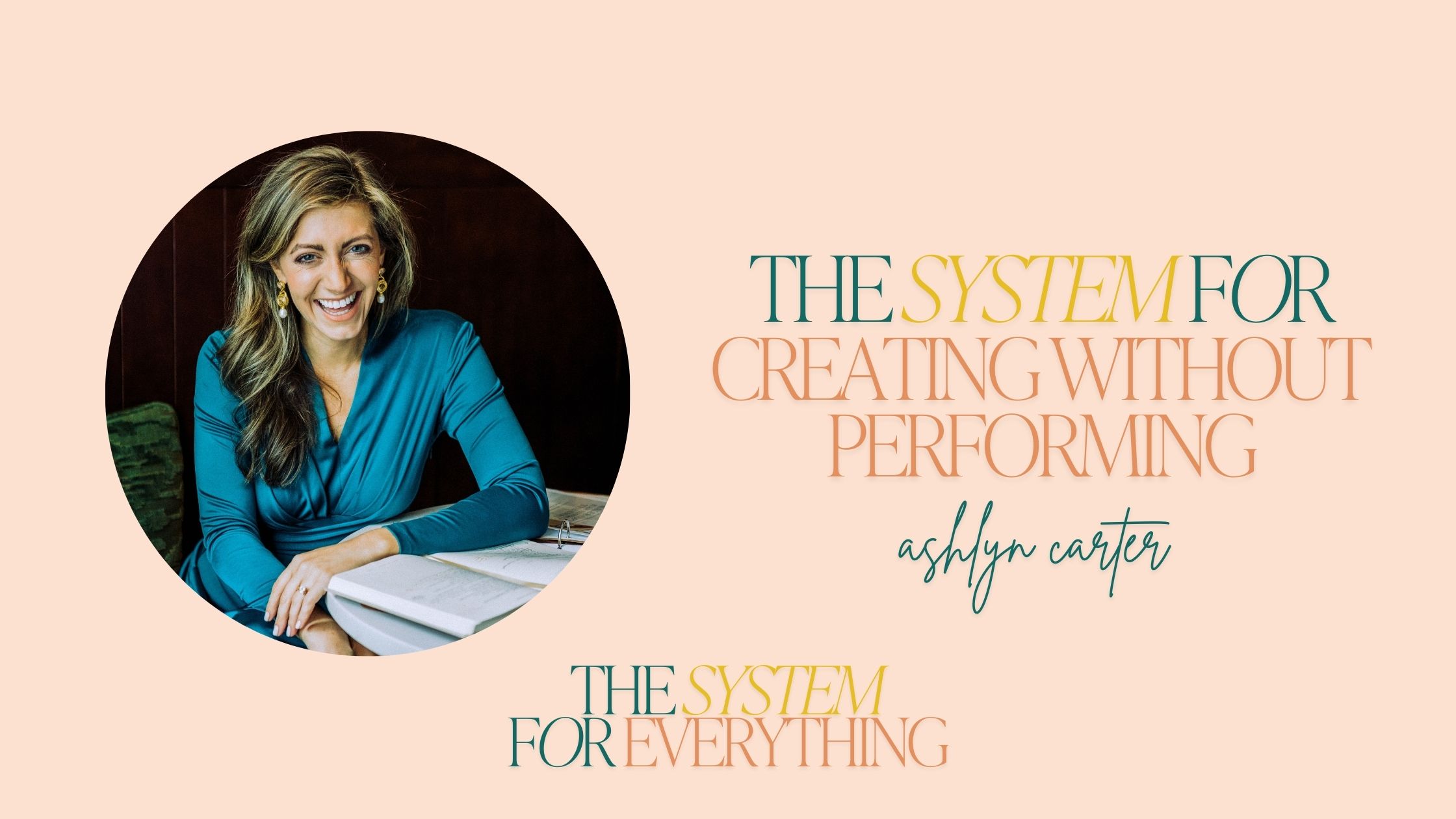
Do you ever feel like you’re performing your business instead of showing up in it? That’s the tension I explored in this week’s conversation with Ashlyn Carter, the conversion copywriter, messaging strategist, and quiet architect behind some of the internet’s most powerful brands. While this conversation started about copy and strategy, it quickly turned into a deeper exploration of voice, vulnerability, and the courage it takes to lead your business with clarity instead of performance.
This episode is brought to you by Enji:
Tired of winging your marketing? Enji takes the guesswork out of showing up. This all‑in‑one marketing system was built specifically for creative entrepreneurs who want consistency without burnout. Plan, schedule, and track your content with intention—so you can stay visible, stay top‑of‑mind, and still have a life.
Why writing with purpose beats writing for applause
Online, it’s easy to slip into persona mode: you start writing for the algorithm, the expectations, or the niche, and suddenly, you can’t hear yourself anymore. Ashlyn names this shift easily, the difference between writing more and writing what matters.
She’s not just a copywriter. She writes to build transformation and that shift in mindset is essential. If you’re constantly chasing visibility without a clear voice, your message might sound great, but it won’t stick.
Your voice is your greatest asset, but only if it’s yours
Ashlyn shared how her journey from journalist to copywriter taught her to treat writing like an integration of art and science. “Persuasion,” she says, “is addictive.” It’s not in a manipulative way, but instead, it’s about understanding what people need to hear, what objections they carry, and how to lead them through change.
As someone with a background in performance, I resonated deeply with her story. When you grow up being trained to “project” and “polish,” it takes unlearning to realize your real voice is enough. Ashlyn calls this her “dog on a bone” energy: the refusal to let go of writing that actually reflects you, not the version of you that trends well online.
Spot the difference: performing vs. connecting
We talked about how quickly the internet can warp tone, especially for writers. Even when you know your voice, it can get blurry fast. So how do you know when you’re slipping into performance mode?
Ashlyn says to look for these signs:
-
You’re editing while you write.
-
You’re holding back, afraid of what “they” might think.
-
You feel drained after writing, instead of energized.
That’s when you pause, step back, and check in with your “why.” Your mission. Your values. The audience you actually want to serve, not just impress.
The system beneath the words
Let’s talk about process, because Ashlyn doesn’t just write from inspiration. She writes from intention. Her system starts with architecture before copy:
-
What is this section supposed to do?
-
What does the audience need to believe next?
-
How can I present this in a way that’s readable and repeatable?
She maps out the entire structure before writing a single word. That means deciding if a concept should be expressed in a table, a visual, a bulleted list, or a simple headline. Skimmability isn’t optional. Neither is clarity.
Here’s the real shift: you don’t need more words. You need the right words in the right order.
Creative freedom lives in rhythms, not routines
Ashlyn doesn’t believe in rigid routines. Instead, she works in rhythms as flexible containers that allow for creativity without chaos. For her, that might mean writing in a journal one day and a random Google Doc the next. The point isn’t where you write, it’s how you write: unfiltered, uncensored, and then edited.
This flexibility allows her to maintain creative integrity while running a lean, efficient business. Because burnout doesn’t come from doing the work, it comes from overworking the wrong things.
Why scaling back isn’t failure—it’s strategy
One of the most powerful parts of the episode came when Ashlyn shared how she intentionally downsized her team and rebuilt a more spacious version of her business. At the height of her agency-style growth, she had 14 people in Slack, multiple offers, and a calendar that felt like a constant obligation.
Then real life hit: her mom suffered a medical emergency. Her husband traveled constantly. Her kids were still tiny. Something had to give.
Instead of pushing harder, she pulled back.
-
She paused hiring.
-
She returned to 1:1 client work.
-
She reassessed her “enough” metrics.
The result? A business that fits her actual life, not just the one she thought she was supposed to build.
As she said: “Success is a heck of a distraction.”
Visibility isn’t always the goal. Integrity is.
Ashlyn is the face of her business, but that doesn’t mean she owes anyone performance. We talked about what it means to show up clearly, even if it means being misunderstood. Even if it means silence. Even if it means saying, “I’m still figuring it out.”
You don’t have to explain everything to everyone.
You just have to know why you’re doing it.
And that kind of leadership? It’s quiet. But powerful.
Connect with Ashlyn:
Website: ashlynwrites.com
Instagram: instagram.com/ashlynscarter
Review the Transcript:
Julie: Welcome back to the System for Everything podcast. Today’s system tip. Wanna show up consistently without burning out? Just film one video and post it every single Thursday until someone says something. All right. Today we have the one, the only Ashlyn Carter. You know her, you love her. There’s a very good chance you have copy pasted, a headline she has written into your own Google Doc before changing one word and call.
It done. Ashlyn is a sought after messaging and positioning strategist, conversion copywriter, and faith-driven business educator for creative entrepreneurs who’d rather not sound like everyone else on the internet. A former journalist and corporate PR pro, she left the hustle of big brands to help small business owners write words that sell.
And still sound like them through her signature curriculum, copywriting for Creatives, the copy bar template shot and her client work, Ashlyn and her team have served more than 150 clients and more than 20,000 students. Her work has supported brands like Jenna Kutcher, Amy Porterfield, Delta Airlines, and Boss Babe, and has been featured in Forbes Creative Live, and Shopify.
She is known for her psychology backed storytellers approach to direct response. Copy her obsession with optimizing conversion metrics and her ability to make complex strategies sound simple.
Ashlyn: Welcome, Ashlyn. Thank you so much. This is an honor also, you’re a nut. That’s hilarious. I hope that people have done that with the Google box.
Because that was their intention. So that would only be good news to me to hear. TBH.
Julie: Alright, we’re gonna start, as we always do with our system, reboot. A quick reset to start our episode with some humor and humanity. What is the copy cliche that you would like to ban forever? If it’s this question, pretend it’s not.
Ashlyn: What is the copy cliche? I mean, that long, long doesn’t work. ’cause it does in capacity. Yeah. I mean, I think a lot of things have changed over time. For sure. We could talk about that. But um, no, I still see. I, I look at numbers all the time, so, um, it’s just gotta stab differently.
Julie: What is your go-to dinner when you are too tired to even reheat something?
Ashlyn: Okay. I’m about to sound like an ad, but there is this brand, it’s actually, you’re Texas, it’s called Good Ranchers and I Oh yeah, yeah. Like, or like the life hack has been ordering. Like pre, here’s the thing, here’s the thing about chicken, like cutting it, cutting off the stuff, you know, hammering it like not my favorite.
Thing. No. And so ordering meat that has already, that has happened, that has, that has occurred and it’s That step has been completed. Yeah. Yeah. That step is done. It’s indivi. So I can pull out, you know, like depending on who’s in town out of my family of five, and then like I can pull that out the night before.
That has been so helpful. I’m a crockpot, girly, and so those are probably my two, like having meat man. ’cause I can’t tell you the number of times that I’ve been like, oh, we have no meat in the house and I have to go to the store with three children,
Julie: which is an
Ashlyn: adventure.
Julie: I don’t even take my one baby to the store.
Right. It’s, it’s, they, they, I’ve taken her once and I was like, well, this was the worst. And, and she was completely fine. I was just like. Because I couldn’t walk away from my cart and like I had to like add a diaper bag with, I was like that, like she was fine. Yeah. But I didn’t want,
Ashlyn: yeah, I, it’s, it’s a lot.
It takes, like, you have to understand there will be 30 extra minutes added, so that’s why Yeah, like five o’clock when I realize that on a Thursday is not the best timing. So that’s why I like having man meat that I can pull out the night before. Game changer. Once I started doing that I was like, what have I been doing?
Julie: So, alright. What childhood obsession are you still not over?
Ashlyn: I think people know this ballet I’ll never get over. I love it ever.
Julie: I will never get over the fact that my mom wouldn’t babysit my tamagotchi and let it die while I was able to sleep over. Okay. Rude. Hope you’re listening to this mom. Yeah. Rude.
Ashlyn: Wait. Let’s discuss Tamagotchi versus Giga Pet Tamagotchi for you. I guess. I don’t even know what giga is. What that was like the competitor. I don’t know which came first. Oh. But they were Tamagotchi. Those were like the egg shape. Giga pets were more triangle shape. Okay. They were the same thing.
Julie: Yeah.
Ashlyn: I was a
Julie: tamagotchi girly.
Yeah. Loved it. Those were great. Honestly. Bring ’em back. Yeah. All right everyone. You have met the personality. Now meet the powerhouse. Ashlyn has helped hundreds and thousands of business owners sharpen their messaging, but her real magic isn’t in writing more. It’s in writing what matters. Here’s my conversation with Ashlyn on the system for creating without performing.
Okay, I wanna start with your craft. It’s not. Just your business, like you have worn a lot of hats, journalists, performer, copywriter, business owner. Yeah. But I mean, at your core, you’re a writer and not just a strategist or a marketer like you are a person who, for a living, shapes words. So you are a copywriter through and through, not a content creator, not an influencer.
What has that distinction meant for you?
Ashlyn: I love that. I think what I’ve learned over time is realizing there’s a through line with everything I did, and there was a combination of art and science, whether it was ballet or copper plate calligraphy, which I know we both started in Wedding World. Yeah. Or copy itself, journalism, like there was always this blend of art and science that majored a little bit more on the technicality.
The science of it, but was wrapped in an aesthetic package. And so I think I’ve always loved that. And then the longer I was in messaging land, I fell in love with the persuasion tactics of it and the argument and the, the logic. And so that opened the door to me, like being more interested in studying logic itself.
And because people will come, you know, when you. Present any offer to anybody, no matter your business. People have objections. So how can you combat those in a way that’s persuasive and winsome? Man, that puzzle is like addictive to me. So I think that’s where, I don’t know, does that answer? I think that is just like the, the longer I got into it, the more I was like, man, I am a dog on a bone when it comes to this.
Like, it is fascinating to me and I can’t get un fascinated. So, um, that’s, yeah, that’s what draws me to the industry.
Julie: I love that. So how have all those different backgrounds then shaped the way you approach voice and clarity?
Ashlyn: Yeah, they’ve kaleidoscoped for sure. I think I see little glimmers pop up.
Because as a writer, this probably goes to a lot of creative Bens. Um, the more curious you are about life, the better you are at your craft. So being somebody who writes it behooves me to be interested in a lot of things. Yeah. Or be curious about, um, and ask questions. Be the questions asker. I know probably a lot of us who are entrepreneur types were the type growing up that was like, but why?
But why? And so that I think, shapes a lot of what I do now because whether it’s working for a client. Or for my own business, getting that like three levels deep question answered is candy like. That’s where I like to hang out and figure that out and then measure it again. That probably shows that I have joked before, like I wasn’t really a math girly in high school or anything until I met marketing math, and then I was like, oh, this makes sense.
This is so good, because then you can kind of get a diagnosis on if what you did. Even though it felt good or you liked it, like no, you could actually get out there in the arena and see how did it land and what happened with it, and then play with it and analyze and scale it, um, or alter it from there.
Julie: Do you remember when you started to feel the pressure to perform your work online instead of just do it?
Ashlyn: That is a good question. Maybe six months in, maybe like. Because you get going and there’s that magical space where reality is suspended and it’s just you chasing down dreams, you know? And you, you don’t know what you don’t know, and they can tell you what you don’t know, but you don’t know it.
So you’re just in this willful or unwell. You just, it’s, it’s so magic. And then success starts to hit. And I told somebody recently that. I hope this is the word okay to say. I’ll say it though politely. Success is a heck of a distraction we’ll say. Yeah. So when you get a little bit of winning or winning clients or just realizing you, you’re, it’s gonna work.
You know, like the spaghetti hold when you get that momentum, behold yeah, the spaghetti stuck to the wall, dang it. Like you’re not expecting that. And then you start to get a little more and a little more and a little more. That doesn’t happen very long. Or at least it didn’t for me. Before you’re like, oh, now I have to keep the spaghetti up and throw more spaghetti that lands, and then like that becomes the new normal and then you have to do it again.
And so like that performance, that at least was my experience, that it was kind of like once the ball got rolling, it’s, there’s the lie that you have to constantly be on the up and up for that to be successful or you know, for you to be performing at where you should be. But like status quo. Is good too, and is success too.
And so, and it takes a lot to stabilize and, um, especially for a lot of us who are mothers and you know, like we’re, we’re doing multiple things, so like, just, just keeping it going this day and age is, you don’t have to be constantly climbing to the next benchmark. Trust me, I’ve done it. It’s exhausting. So I think that’s one thing that I’ve had to realize in time too.
Julie: I wanna talk more about kind of that space between. Having a real voice and like a polished persona. ’cause especially for writers, like the internet can really warp tone before you even hit publish. And for someone like you with a performance background, I have a performance background too. I mean, those lines can really blur fast.
So I know you’ve written for. So many different industries. When you’re writing for yourself, how do you avoid slipping into a persona instead of your real voice?
Ashlyn: Yeah, three things. One, I’d never start with AI ever. It was Ryan Leveque interestingly said in his newsletter the other week that, and he writes, you know, to thousands, he said, no matter what.
Whenever I write without ai, it always gets more engagement. And so I do think, um, we’re, we’re past the bell, like people can tell, so Oh yeah. I think that’s like one big thing. A second is I don’t edit while I write. I always write and then I come back and edit in a different head space. Oh, that’s smart.
Yeah. ’cause you’ve gotta like, you’ve gotta get it out and shape it and you’ve gotta write raw. And then I think the third thing is I usually try to write in whatever medium feels good at the time. So not forcing myself or beholden myself. And I’ve met, I mean you, we love systems. Like I love sometimes being like, but I write in this Google Doc because then so and so takes it from my team and does this and that the other to it.
But like sometimes I don’t, if I write in that, I’ll feel. Compartmentalized or boxed in, it’s easier to form notes or to, you know. Pull out my journal or to just like open up a random Google Doc in a random folder that no one’s gonna ever find unless I label it and file it appropriately and write there.
And so I think like that being freed up to just like write where you can get the, the moss ball rolling down the hill and then worry about the other things later if you’re stuck or if you can’t, um, shake out of it. Because I do think we get in ruts sometimes and that that’s me. That there may be plenty of people out there who can write.
You know, they’re disciplined enough to like hit open and write in the same thing every single time and feel freedom to that. But I tend to get creatively in a rut when I get in too much of routine. Yeah. So that’s how it’d be for me, for sure.
Julie: What are some signs for you that you’re starting to veer into that performance instead of purpose area?
Ashlyn: When I gate keep myself, when I censor myself, if I find myself holding back out of fear of man, that’s when I know I’m entering to a space that’s not good for me. Um, and I’ve been, I mean, again, 10 years in business, tons of clients, medium sized li like I’ve been in places where I’ve felt like I have to do my tap dance for.
A certain group of people and I have to kind of check back and pull back to, okay, but what is, what is truth? What do I wanna say? What I feel led to say, that’s hard to get back to sometimes. And I think, yeah, it requires a constant. A constant coming back to like, what is, what are my mission? What, what is my personal mission?
What are my values? Like, where do I wanna operate from? Because it, it can quickly, and I, again, I say this too, knowing I’ve had the privilege of being behind the scenes of some incredible businesses, and I have seen sometimes that there’s, sometimes it happens where you feel beholden to the audience, but do you still love the audience?
You know? And that’s. Or can you fall in love with them again if you don’t, you know, all those kind of questions. So that’s what I noticed for myself when I’m like, Ooh, okay. I need to skate back. If I, um, start to feel those feelings.
Julie: I love kind of that idea of checking in with your why. Yeah. When you’re writing.
’cause I know even when we know what to say, it’s easy sometimes to perform instead of connect. But I wanna go, I wanna jump to systems and processes, which we love. Yes. Because the final product, I mean. That’s only half the story. And for creatives, the system behind the scenes is often what makes that work sustainable.
Um, so I know you’ve spoken about rhythms over routines. How does that show up in your actual writing workflow?
Ashlyn: Okay. In my writing, I am very big on copy architecture and having some sort of. Again, I mentioned earlier persuasion and rhetoric and logic. Like having an order to the argument is so helpful for me because, and I kind of, I’m not trying to sound like I’m talking outta two sides of my mouth ’cause I said, you know, write where it feels comfortable.
That would be like if I’m just like writing from the heart, like a newsletter or an update or a post. But when I’m writing sales copy, like strategic copy that is made to get a dollar, get a click, whatever I. I need to understand the order of the argument. What is the logical Yeah, of course, operational step that needs to come after step to win the sale or win the idea or the concept.
So. I oftentimes start with some sort of an outline. Again, these are like ones that I’ve sold and I teach every now and then I’ll riff on those for sure. I, I do plenty of day rate clients and I’ll, I’ll reassess and look at the offer and what is the going, you know, what is the going nomenclature, what is the going thesis out there about what they sell?
And then like, how do I need to adapt that and what their people are actually saying when I look at voice of customer data and what needs to be said, and do I, do I have variation on a theme with this? You know, order that we’re gonna put on the services page or the sales page or whatever. So that’s usually how I approach it.
It is very like, I will not start writing until I get the order first and outline, look at this, the job of this section is to do X. The job of this section is to do X, and then I’ll kind of spec out what that needs to look like. Is it a, you know. Is it a headline and is this, is this concept gonna be best communicated in a visual, best communicated in bullets, best communicated in like a table, best communicated in a couple of paragraphs?
Like how can the information come across? Because people are skimmers, people are quickly reading on websites. So like, how can, they’re not gonna read the words that they can’t get through them. And of course we only know, you know, 20% is reading every single. There’s reading the page anyway, so how can we help them get through it in a way that argues and is yeah, is skimmable, so they hit the high points.
So that’s usually where I start. And then after all that, then I’ll, I’ll write it out. And um, so writing usually that’s, it’s definitely the iceberg analogy where. What you see is the, this the absolute tip top of the whole process because there’s a whole gargantuan amount under it. Yeah. Of work that you’re doing to figure that out.
And again, as the business owner, a lot of that, you know, a lot of that you’re swimming in the weeds of, ’cause you built the offer, you know the audience. There was some thread I was reading on X the other day about an entrepreneur had a huge list and she would just never, she would never outsource the email newsletter writing.
’cause that was like. That’s how you know your people. That’s how, or at least that’s how she would really connect. And so, um, you’re actually, I don’t want that iceberg analogy to scare people because you usually. You have all that in your head. That’s why I really, I want to train people to do it well themselves because, you know, you’re, you’re the lion’s share of the information anyway.
Julie: Yes. Um, when you get to the actual copy piece of it, do you have any like rituals or tools or checkpoints that help you, like stay clear and not just be clever?
Ashlyn: I probably. Like I said, I do probably write, this is me per, this is when I’m not teaching it to other people. But personally, when I’m writing copy, I usually am like, I’m free styling, but I am doing it in a way where I am probably checking myself a little, you know, don’t write cliches.
Quick sentence, write, write, like people talk. Like all those things keeps most sentences, 13 words or less. Like I, I do those naturally anyway. I think at this point, writing. And then, like I said, I’ll go back in and Captain Hook, edit everything, but I do try to kind of like go ahead and put out what my thoughts are.
Um, I always keep, uh, like copy bank or copy fodder section at the bottom of a doc. So I can put a little place for my darlings, because there’s so many times where I’ll write phrases, I’ll be like, Ugh, not here. Not here. Maybe not ever, but like, I’ll pull that down somewhere. So I do that a lot and then I, I do this too with clients is give like mix and match options.
So, you know, for a hero section of a page. Here’s an angle that goes this way, here’s an angle that goes this way. And yes, we can split te the split test those, but maybe the client will be like, no, no, no. This is definitely the direction I’m gonna go in. That’s great. But giving multiple, kinda like trying on different hats.
You can wear this hat, this hat or this hat, or we can like do a combo that those are all little kind of, I guess, features I would use when I write
Julie: this episode is brought to you by eng, the marketing system that helps creative entrepreneurs stay consistent without burning out. You know that moment when you sit down to write a caption and suddenly forget to sound like a human?
Yeah, you are not a bad marketer. You just don’t need to do everything from scratch. That’s where Engie comes in. It makes it easy to plan your marketing and will take care of the first drafts for you. So instead of spending three hours rewriting the same caption, you can save those hours and do something you actually like.
Think of Engie as the friend who gently takes your laptop and says, let me take care of that for you. Go to Eng Co. That’s NJ co. Start free today and save time. You’ll find my eng link with a special listener discount waiting for you in the show notes. You made a huge decision this year to scale way back.
Yes. You let go of your team. Mm-hmm. You returned to client private work. Mm-hmm. I know that wasn’t just a business move for you, it was also a personal one. Can you talk about what kind of led you to that decision and what’s shifted for you now that you’re running like a leaner more? I guess spacious version of your business.
Ashlyn: I like that word spacious. Yes. If my voice waves, it’s, ’cause I’ve never talked about this before, but
Julie: That’s right. Hot gossip alert. Here
Ashlyn: it’s, you heard it here first
Julie: guys. Let’s put in like some kind of sound effect. Like,
Ashlyn: so I think it was like in December, January of last year, I started feeling and I, I truly think the Lord tried to get my attention.
My mom had like, uh, two aneurysms. Oh my gosh. In 2024. Yeah. And it was like the first time I was like, wow, I needed to take a month off. Yeah. Because I was in the ICU U all the time. So that I really, after that was like, I wanna reconstruct my business, but I still had a team, 14 people in my slack at that point.
So there was only so much reconstruction I could do. And then, and I. Just for context, three children, six and under. And my husband works out of state, so he’s gone for four and five days at a time and then comes back. So I am by myself a lot. So around December I started feeling like, okay, this is just not working.
Something is major off. And so it kind of like, I started wondering how. How could I, what are my metrics? What is my enough and how could I either scale or how could I change that? I just started holding it with a really loose hand, so I went through, we had one of our, I think it was our second best launch ever in March and.
The day it was midday through midweek through the cart, my husband and I started having some conversations and I was like, something is off. Like the webinars were fine, but like something is off. And I don’t know if it’s just like my heart is changing, but it just like. You know, you, you’re with a woman with intuition, just like you know when something’s off.
Yes. You can’t put your finger on it. Always listen to that gut. Yes. That gut. Yeah. My gut was off. Well, so I start praying and thinking through things. I’m talking to my coach. I’m like, I dunno what to do. I’ve got people on payroll, like when you payroll, it’s like you can’t sleep without being like, are we gonna make it?
Or like, yeah. Lo and behold, I don’t show up in tap dance. People can’t feed their family. So like, that’s on your brain. Can’t shake it. And three discipling, three sweet little souls. It was just like. A lot. And so I am praying and thinking through all this. My precious EA came to me in, I’m looking at my calendar.
This is May. And she said, Ashlyn, I want to go into an office. Like I want a life change from doing remote work. And I was like, I completely get that with your personality. Like it just, she’s been amazing. But I, I got that and I told, I went ahead and told her that time I was like, actually, like, here’s what I’ve been thinking and.
I don’t know what to do about it. And so she was able to kind of come alongside me and help me process through what would it look like to scale back a little bit. And I, I just had her full confidence ’cause she knew me. I mean, she was my ea, she knew me in and out. She knew my, my family dynamics, like she was just so lovely to process with.
And so. Bit by bit. I started to say, I think we’re just gonna roll off it. I’m gonna take a sabbatical ’cause I don’t really know. I don’t wanna close, but I don’t know. Something is off and I just need to figure it out. And so all summer I ended up, so by the end of June, by the beginning of July, I had no, just a bookkeeper contracting, but everyone else I had either put on pause or said I’m, I’ll come back to you when I need you.
And then. I started. So that meant that I took on some one-on-one clients this summer that we had lingering. And lo and behold, I realized, uh, as it turns out, I do love what I do. I had just gotten myself up from a management position to where I was not in the weeds of it. Mm-hmm. And that like, it pulled me from the art and the science of it, like I was talking about earlier.
And I realized like, oh, I do miss that and I do, I wanna get my hands dirty again and play around in it. And so. That I’m still, to be quite honest, I’m still reshaping and figuring out what does that look like now? But that was a aha moment for me. And then interestingly too, I’ve had some more like wedding clients or fine art clients and I was like, wow, I really, I really love this.
Like I really, yeah. And you got to dig your feedback into that. Yeah. You love pulled out a little bit to a place where I was the shock caller and it just wasn’t. Again, I loved that at a certain point in business, but I just, I really think it was like managing little humans managing that. I was just like, I.
I wanna play at some point. Yeah. I wanna, you know, and so yeah, I think then I’ve gotten, lately what that’s looked like is I’ve gotten specific about, okay, how, if I am, you know, and that means having my children at home more, which I’ve loved. Um, oh, kind of reassessing my role in the home and. I feel like I was like, I needed to go to wife school.
I need to go to home ed school. Like learning some things that I’ve just like not done and didn’t realize I love them. So that’s, that’s been a whole nother thing and I’ve really enjoyed it. So now my, I’m trying to figure out how do I take. 15 hours a week, which is about what I have when children are either asleep or off at nursery or at school, big school for the bigger ones, and con reconstruct a business that is life giving, but then fits after my primary duties are taken care of.
What does that look like? And I know, yeah, be your systems nerd. I love systems. And so I’m like there the, the possibilities are. Are so different than they were five years ago, three years ago, even on like how you can run a very lean, and I think for a long, I resist because people so much and really enjoyed having.
Human work and eyes and ears in, in my business and I’m I, there is such a time and place for that, but I think like that’s been what the fun puzzle for me now is like reconfiguring, like, how will I do customer service? How will I do? And. Then pulling in people. But it’s just, it’s a whole, it’s a whole new world with that.
And so, um, that’s kind of where I am now. And it’s been, I’ve, I mean, our marriage has never been better. I’m having way more fun as a mom. They, man, they grew up too fast. That’s, I kept saying, that’s my business push too. I was like, I don’t know. They’re squishy hands just get really bony fast. And I, it took me three children for me to realize, for the Lord to kind of finally be like, Ashlyn, I’m trying to get your attention.
Like they will be, they will be. Older later They are so my kid children are so little and I’m that you just, it took me a long time to realize that
Julie: I think we’re also faced so much online ’cause there’s so many people who teach, you know, scaling and hiring a team and this is what you have to do and you have to become the CEO and you have to do all these things and that is awesome for some people.
Preach. It is not the only way to get to where you wanna go. It’s not the only way to have a paycheck. It’s not the only way to have the life you want. Yep. Um, and so I think that that’s really important for people to hear that kind of honesty about what works for you, what works for your family in this season.
To get to that is very rare and it’s generous and you know, it’s, it’s easy to talk about growth and scaling. It is harder to talk about stepping back in service of something that is to you and you are the one that matters more important. So good. But you are, you are the face of your business. I mean, you are, your name’s on the business.
Your voice is in every launch, and it’s in, you know, your clients come to you not just for for copy, but for the way you teach and lead. And I think that that kind of. Visibility that you have can be very powerful, but can also feel really tricky to navigate. You know? Especially for someone like you who is so thoughtful about boundaries and voice, you know?
Was it always clear to you that you had to be front and center of your business or. Did you, did you try to resist that? You know, I’d, I’d love to hear about how it’s felt for you personally, especially as someone who identifies as an introvert and didn’t necessarily want to be the face.
Ashlyn: Yeah, yeah.
Spoiler. I’m a huge introvert, like would always rather just be curled up with a book and some tea then talking. I will have verbal hangover after this podcast. I do after I speak at anything, anytime. I just, that is fair. Just introvert life, right?
Julie: Yeah.
Ashlyn: Um, but you wind up in this place sometimes I’ve laughed.
It’s like in the Bible, God has certain commands for Moses to do, and Moses is like, please just pick Aaron. My brother, he’s talkative. Like just Aaron. Just Aaron. And I’ve felt like that before. I’m like, just, I don’t, I’m not comfortable, but it. Sometimes you do find yourself in situations where, like you said, I think that’s client lead.
You know, if you serve any clients, you’re, as it turns out, you have to talk. So I think that you asked like how that realization hit. It definitely for me was this slow burn of just all of a sudden looking up and being like, oh, I didn’t really mean to get here. But I guess there people. For some reason want to hear what I have to say on a topic and like, I dunno how that happened, but that’s there.
So I think that happens to a lot of us. I would say that identify as being a little bit more introverted. Um, and then as far as how I handle it, one of the biggest learnings lately has been realizing that it’s okay to, I’ve always kind of operated that clear is kind and I believe that. But you also have to be un or comfortable with being misunderstood.
Or you, if, especially like this season of kind of not knowing really what, like ha just ha needing some time to sabbatical and be like, I, I don’t know what, what I want or what’s next. And like I know that might mean radio silence and I’m okay with that because. Like, I’m okay with somebody who I don’t know at all.
Not knowing, like not understanding because the people that matter most to me, my circle, people I see every single day. People that are, you know, in, on my street, in my community, at my grocery store, at my church, in my Bible studies, like those are the people that I’m doing life with. And they know like that’s their opinions and what they, you know, like that matters.
I know if that makes sense. But being when you have an audience, you do kind of a little bit, have to be okay with. And I, it is. I think that’s been hard too as a marketer, when you’re always thinking, like you have to be clear. You have to like get it on, you know, 0.8 seconds. They have to understand. But there’s some things in life that like some people are just either not gonna agree with or not gonna understand the way that you see it, and like that’s okay.
So it’s like holding those two things in your hand at the same time. That desire to be heard clearly and kindly. And from a conversion standpoint, all that, like specifically, but also knowing that there’s gonna be times that. It’s just you have to be that. Yeah. That my business coach is the one that said that to me.
She was like, Ashlyn, I, are you okay with being not clear to everybody right now? I was like, Hmm, I don’t think so. That is a new life sensation. So, um, that, that might be interesting for some people to think through.
Julie: Yeah. What does it look like for you when you show up fully as yourself and not. A performative, polished persona of you,
Ashlyn: man, nothing feels better.
Yeah, it feels so good. Yeah, and I think too, like. Just realizing I, I was actually talking to, she is, she’s been a client. She is extremely large following and she shared with me on a call recently that we had that she used the word ladies in her email one time and then she was like, but all the men on my list, like this is going on in her head.
She was like. But I don’t wanna ostracize them. Like, oh my goodness. And then she like, ended up, she was like, no, let’s just say it like I, I want, I have a heart for these women. And so she said that and like made that call and she was just saying like, it felt good and like yeah. ’cause what she
Julie: had to say specifically, that’s who she was talking to.
Ashlyn: Exactly. Yeah. And that like resonated so much with me and I thought like, ’cause I felt like that before. I’ve been like, I, ’cause I see the emails, you know, for some, I know you talk to women, but I’m here too. And I think you, you know, and you’re like, oh, I’m so glad you’re here. But like. I, I don’t, I don’t want you to feel not welcome, but like you, I think I’ve finally just come to the place where I’m like the people, I mean, I followed businesses that don’t speak specifically to me sometimes if I really want to,
Julie: and that’s okay.
I followed so many mom related businesses before I was a mom. Yes. Because all I wanted to be was a mom. Yeah. And so, yeah, I mean, I get it sometimes. Sometimes not all content just as a consumer is for you. Yes. That’s okay guys.
Ashlyn: Okay. And we can say it’s like cerebrally, we know that. But living, like living that in your content and being okay seeing the number, you know, like yeah, that is a different holding it is, can be a little bit different, but um, yeah.
It feels good. You asked how it feel. It feels so good when you’re like, I’m, I’m great with that. That went out there, like, that’s, yeah, let’s have more of that. Because then you, you bubble up and you start seeing the client in cruise, you’re like, oh my gosh. That like I am now. I’m coming alive. Like I can’t, I have one client recently where I was like, I cannot, I have to tell myself to step away from this.
’cause she wasn’t buying like. However many hours I, I was like, I need to serve her and honor other clients who’ve paid this for this many hours. But like, I can’t stop ’cause I’m so obsessed with what she does and who she is and who she serves. Man, that kind of work feels so good.
Julie: You’ve helped so many clients refine their messaging and I would imagine that for many of them, like the first draft is full of things that they.
Yeah, think they should say. So I wanna talk about how you help others drop their act and find the real message underneath. So when you’re reviewing a first draft, like from a client, if it’s something they’ve written, how can you tell that they’re not being themselves yet?
Ashlyn: That’s so good. There’s a spidey sense.
There’s a spidey that comes up that I, I really don’t think you have to teach. I think other people could see that too. Like if you know the personality, you read the writing, you can just tell, right? Yeah. I think what has been fascinating now with AI is you could have this little hypothesis, this antenna up, and then I always use AI to fact check me out.
Or like, not fact, but like, is there a mis you know, here, or what, what is the tone that you read from this or what is the, and I’m telling you what, when it, when you have your sense and like you run it through Rocky, run it through Chatty G, you run it through Claude and they all say the same thing. Then you’re like, I knew it.
And so that I think is. That is so fascinating when you’re, you have a concept and then you are able to run it through multiple tools and the output is the same hypothesis. I think what’s interesting from a service provider standpoint is a lot of us are at, in a place in services where you will. Listen to your client, you’ll get that first deliverable ready and you’ll give it to them and it’s on the presentation, right?
But then every now and then they’ll be like, I just think you know, this is off, or this is off, blah, blah, blah. And a lot of us have receipts, right? You’ve got the data, you know why you made the decision to be a certain way. And obviously we all need to accept constructive criticism and there’s art in what we do and there’s objectivity.
But um, I’ve just found so many times it’s really interesting when you can. There, there’s a level of needing to be able to go to the client and communicate to them that like, because like it’s happened to me before, when I work with vendors or contractors, you are, they’re mirroring back to me what I said and what I like.
They’re, they’re acting as a mirror and I paid them to act as a mirror to me. So there’s some, a level of me needing to be like, okay, if then something, what has to change so it can to another’s ears or eyes be perceived the way I want it to be perceived. That is. A really fun, I had a big experience with that with the client this summer that was so fun.
And she ended up, I mean, at the end she was like, I get it. Like I was being entirely too ver wordy on everything. You were trying to cut it down. It wasn’t to like dumb down what I was saying. You like the light bulb clicked on for her and what the goal of messaging was, but. That can be a really interesting tension to sit in as a, um, service provider.
’cause you’re, you’re the mirror showing that back. But you have to do it obviously, with grace and servant leadership. It can, it can make you, I definitely run a lot of chat. GPT help me say, this is what I’m trying to say. How do I say this in a way that gets their buy-in, but also communicates clearly. I love that.
Keeps more boundaries. Yeah.
Julie: What do you wish more business owners understood about Real connection Through Copy
Ashlyn: that I, like I said about the AI thing, you can, and I, I mean, I put out templates all the time and I want people to use those and get, yeah. An expedited first draft, but when you put your thumbprint on it, your personal story, the way you talk on it, it’s gonna be exponentially powerful.
And don’t be afraid to do that. We’re in a time where you can do that and that is rewarded. That’s what people want more of. And so like, go for it.
Julie: I love that, Ashlyn, please tell everyone where they can find you online, how they can work with you. I know you’re focused a lot these days on, on your vi IP days and your membership, so definitely, especially talk about those.
Ashlyn: Okay. Yes. I’m at ashlyn wrights.com or on Instagram at Ashlyn s Carter, and um, oh, yo. Like I said, I’ve just really enjoyed half day, full day rates. Well, I just, I’m enjoying being in the cockpit again and getting to, um, do the marketing math and get nerdy and figure out why things are not working. And then I have a membership that I love.
People hop in there and we, I mean, we do, we do weekly, uh, monthly teaching calls and, um, ask me anything. And I just, it’s, it’s like business coaching with, from a messaging standpoint, which. I adore. So those are my two big, um, focus points right now, which is what I can handle with my new
Julie: littles. Awesome.
Yeah. Great. Ashlyn. We end every episode with our system. Shut down a little. Uh. Little final list ritual reflection to, to close out our conversation and remind us that we’re, we’re all still just people trying our best. And so today I’m gonna talk about the five things I wish I could copy and paste in real life, because let’s be honest, copy and paste is the greatest invention of the modern age.
But in real life, there are no shortcuts on your keyboard for the one outfit that makes you feel unstoppable. The note you left yourself, that actually made sense later. That 2:00 PM iced coffee that hit just right, the version of you that didn’t spiral over a typo and a reel you actually enjoyed making.
All right. That is it for today’s episode, everyone. If this one made you breathe a little deeper, rethink the way you show up online or want to delete that fourth draft of your about page, good. That means we’re onto something. You don’t have to perform to be powerful. You don’t have to be loud to be clear.
You don’t have to write like anyone else to be worth reading. And if you needed that reminder today, copy and paste it. I won’t tell. All right, everyone, take care of your business and yourself. See you next week.